There was one, and it is gone. Mount Baker Lodge — a four-storey, 100-room hotel in Heather Meadows — opened in the summer of 1927 and burned to the ground on August 5, 1931. Nothing permanent replaced it. Ninety-five years later the ski area still states plainly that there are no accommodations at the ski area, and the nearest beds are 40 to 45 minutes back down the valley.
People search “Mount Baker Lodge” expecting a hotel at the bottom of the lifts, and they are not imagining it — there really was one, and the photographs are extraordinary. What ended it was a morning in 1931, the Depression that followed, and a snowpack that turned a twelve-month building into a ten-week business.
Is there a lodge at Mt. Baker Ski Area?
There are three lodges and not a single bed in any of them. All three are day lodges — food, rentals, lessons, a bar, somewhere to put your boots on. Mt. Baker’s own accommodations page says it in one line: “While there are no accommodations located at the ski area.” Everyone who stays overnight stays down the highway.
| Lodge | Where | What it is |
|---|---|---|
| White Salmon Day Lodge | MP 52, lower base, 3,500 ft | Main food court, The Crow Bar, rentals |
| Heather Meadows Day Lodge | MP 55, upper base, 4,300 ft | The 1950s building; retail, weekend rentals and lessons |
| Raven Hut | Mid-mountain | Lunch counter, beer and wine |
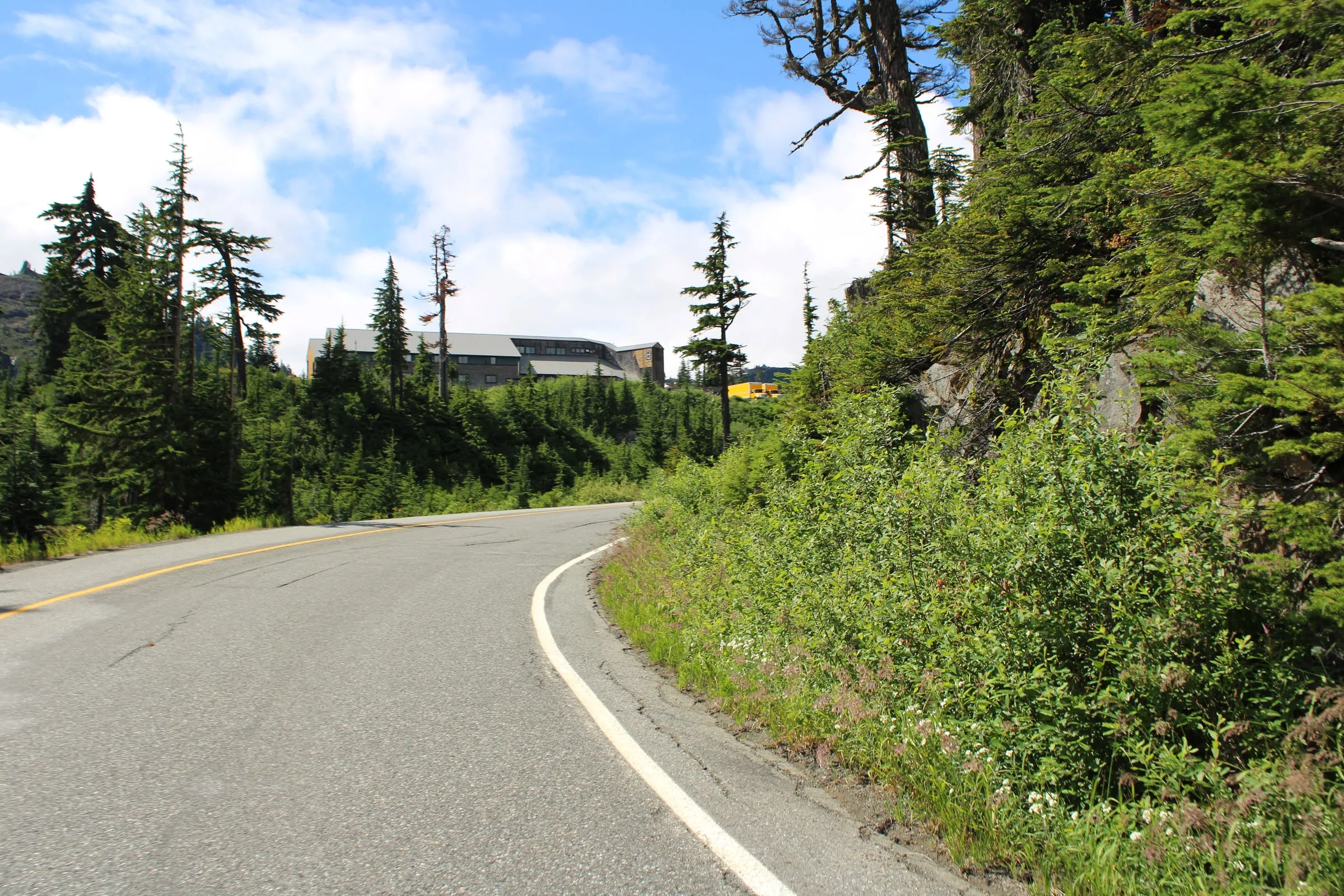 The White Salmon day lodge above SR-542 in July, identified as such by the photographer. This is what “lodge” means at Mt. Baker: a place to eat lunch and change your boots. Photo: Chris Light, CC BY-SA 4.0. Cropped and tonally adjusted.

The naming is the whole problem. A “lodge” at Mt. Baker is a cafeteria with a boot room. We go through what each one actually serves, counter by counter, in is there food at Mt. Baker Ski Area, and what the mountain charges in our Mt. Baker Ski Area guide.
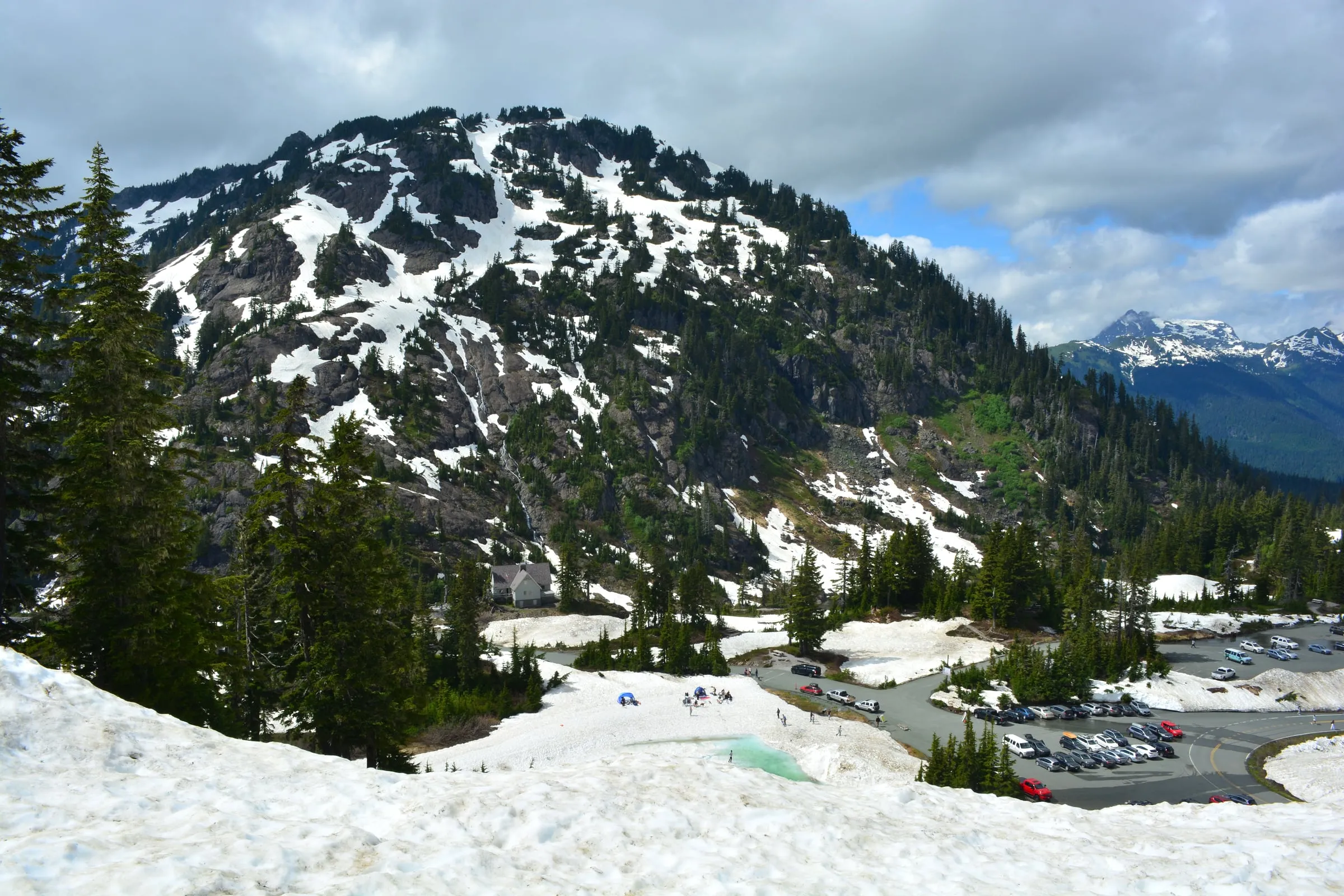 Heather Meadows on 11 July 2022, lots full and the basin still under snow. The lodge stood somewhere on this ground. Photo: Joe Mabel, CC BY-SA 4.0, via Wikimedia Commons. Cropped and tonally adjusted.

What was the Mount Baker Lodge?
A genuine grand hotel, 4,300 feet up a dirt road. The Mount Baker Development Company — Bert W. Huntoon, Frank Sefrit, Everett B. Deming and other Whatcom County investors — leased the ground from the Forest Service and built a Swiss-chalet hotel out of local timber and stone. Seattle architect Earl W. Morrison drew it. It opened in July 1927.
The scale is the part that does not survive in most retellings. The lobby ran 130 feet long and 50 feet wide, with a basalt fireplace whose hearth took a 10-foot log. There were 100 rooms, 60 of them with private baths and telephones, and electricity throughout. A fountain by the entrance ran on spring water piped 600 feet from Bagley Creek. The Pacific Coast Architecture Database records the building at four storeys, constructed 1925–1927. The company told shareholders it had put $500,000 into the lodge, its outbuildings and a camp down at Shuksan.
It was aimed at wealthy guests, with cabins alongside for families who could not afford the hotel. More than 120 people stayed the first couple of nights. Ron Judd, writing in the Seattle Times in 2006, found it compared in its day to Yellowstone’s Old Faithful Inn, with guests swimming in a pond, riding horses up to Austin Pass and playing miniature golf with Mount Shuksan behind the green.
Two opening dates circulate because there were two. Guests were let in on June 30, 1927; the formal grand opening was July 14, pushed back from June 15 because the road was not cleared until July 9. Three to five feet of snow was still lying on the ground at the ribbon-cutting. That detail is the rest of the story in miniature.
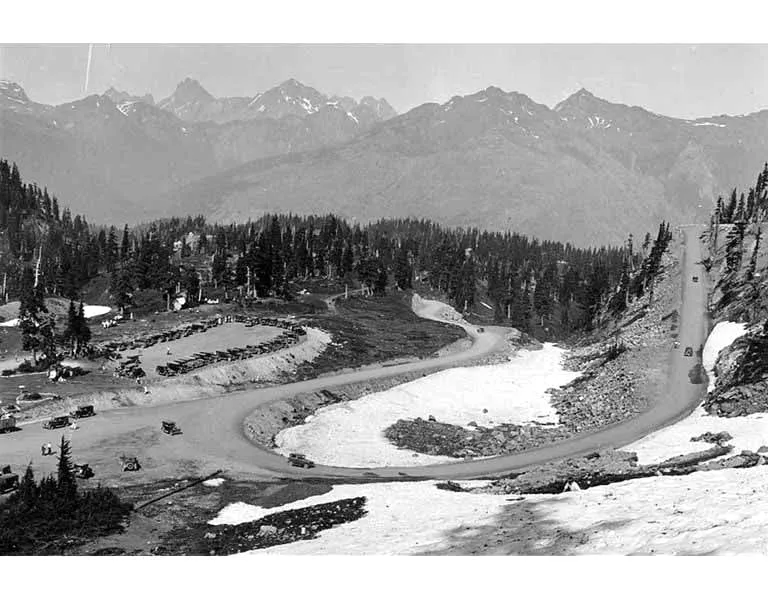 The highway and its parking loop near Austin Pass about 1926 — the year before the lodge opened, photographed by Bert Huntoon, who helped build it. Photo: Bert W. Huntoon, University of Washington Special Collections, via Wikimedia Commons, public domain (published before 1931).

When did Mount Baker Lodge burn down?
August 5, 1931, four summers after it opened. Huntoon was out photographing the sunrise when he saw smoke coming off the building. Newspapers at the time blamed the lodge’s direct-current electrical system; the reported cause was defective wiring. By the time it was over, only the stone chimneys and the tower were left standing.
What burned was the hotel and only the hotel. The Annex, the Heather Inn and all of the cabins came through untouched, which is why the resort could keep taking summer visitors at all the following year — the Heather Inn, built for staff, became the guest building for the 1932 season.
A rumour went round that a stockholder who had never seen a dividend set the fire. There is no evidence for it and we are not going to repeat it as fact. The careful version is the one The Northern Light published in 2022, drawing on Mike Impero’s book The Grand Lady of Mount Baker: defective wiring was reported, the rumour existed, and nobody proved anything.
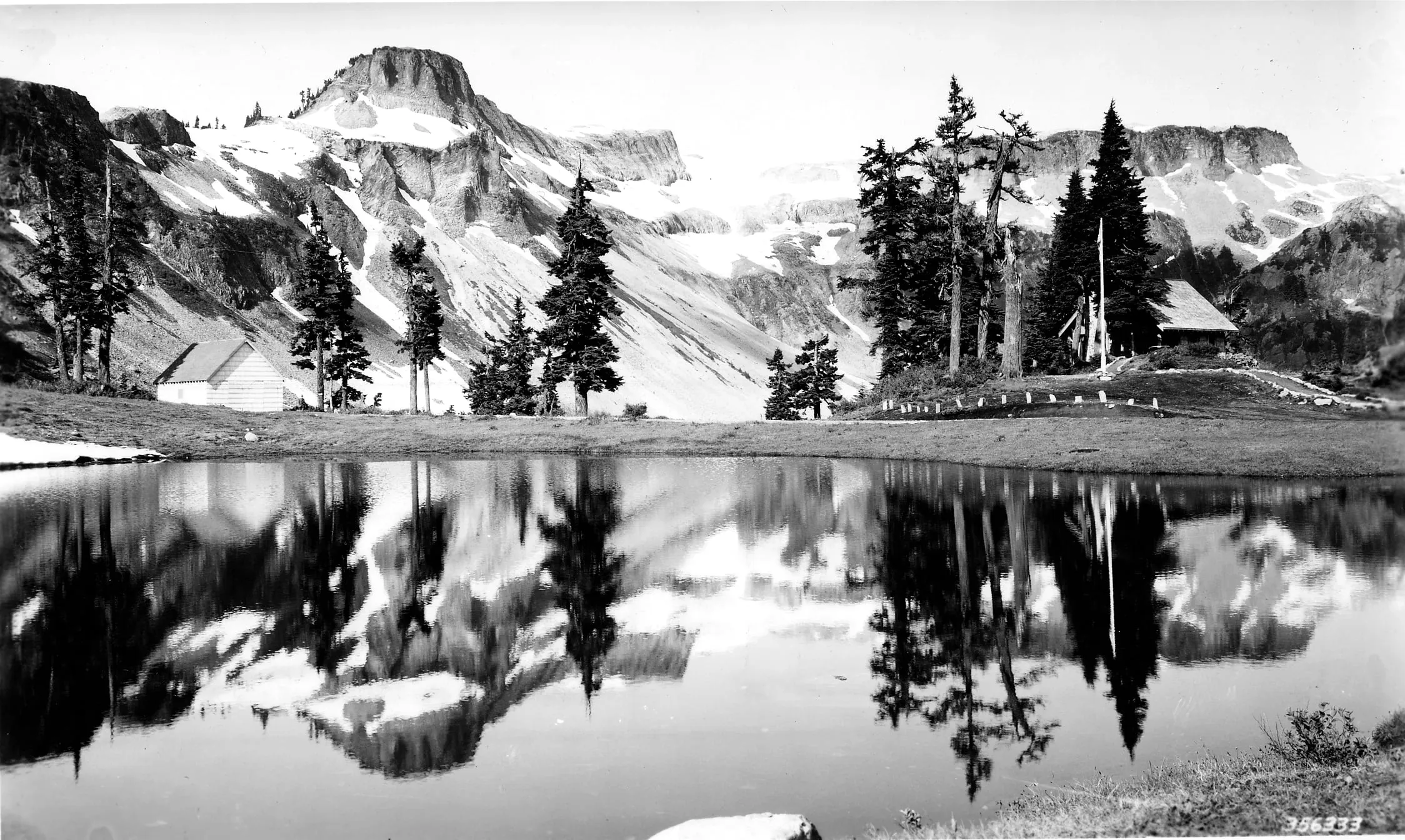 Forest Service archive photograph 356333: the Austin Pass guard station below Table Mountain. The buildings that followed the lodge were this size. Photo: U.S. Forest Service, Pacific Northwest Region, public domain. Cropped and tonally adjusted.

Why was the lodge never rebuilt?
Because the business was already fragile and the timing was fatal. The lodge was profitable for roughly two years, visitation then slowed, the fire took the building in August 1931, and the Depression took the rest. No insurance payout rebuilds a grand hotel into that.
The deeper problem was the mountain. Without winter snow removal the road to Heather Meadows was usable from about July to mid-September, so a half-million-dollar hotel earned money for ten weeks a year and sat under several feet of snow for the other forty-two. Impero’s verdict, quoted in The Northern Light, is blunt: “They didn’t realize the magnitude of what they were building.”
The company wound down rather than collapsed. The highway was pushed through to Artist Point in October 1931. The Heather Inn, shut for two seasons, was sold to the Forest Service in July 1941 for $1,100. In the winter of 1942–43 the state highway department stopped clearing the road because of the wartime gasoline shortage, and that was the end of the Mount Baker Development Company.
Nobody has tried since. The site sits on national forest land inside the Mt. Baker-Snoqualmie National Forest, with no public water or sewer at 4,300 feet, and the only structures up there belong to the ski area. Judd’s line from 2006 still holds: “The only structures here belong to the ski area, and that’s not likely to change.”
What is still standing at Heather Meadows?
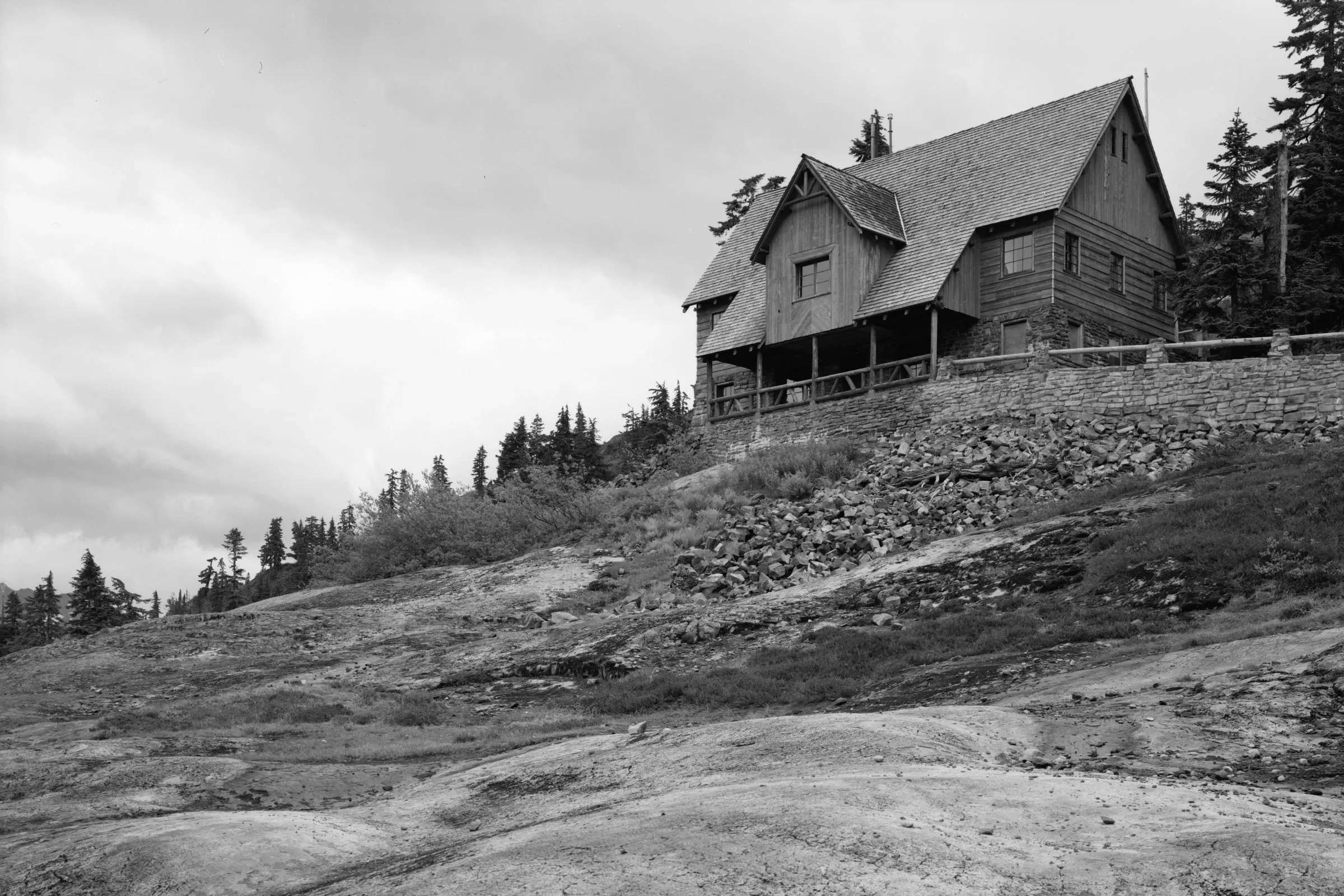
One building predates the ski area as you know it, and it is not a hotel. The Austin Pass Warming Hut was built by the Civilian Conservation Corps in 1940 as a shelter for skiers — two and a half storeys of masonry and timber, with a fireplace and a cathedral ceiling in the warming room. It is on the National Register of Historic Places, listed December 21, 1990, and it is the building in the photograph at the top of this page.
| Year | What happened |
|---|---|
| 1923 | Mount Baker Development Company leases the ground from the Forest Service |
| 1927 | Mount Baker Lodge opens — 100 rooms, four storeys |
| 1931 | The lodge burns, August 5. Highway reaches Artist Point in October |
| 1940 | CCC builds the Austin Pass Warming Hut |
| 1941 | Heather Inn sold to the Forest Service for $1,100 |
| 1950s | Heather Meadows Day Lodge built — still in use, MP 55 |
| 1972 | Warming hut converted to a University of Washington field station |
| 1990 | Listed on the National Register of Historic Places |
| 1996 | White Salmon Day Lodge opens at MP 52 |
The warming hut is now the seasonal Heather Meadows Visitor Center, run by the Forest Service. The Heather Meadows Day Lodge, which the ski area dates to the 1950s, is the closest thing to a descendant: its main level has been restored to the original exposed beams, there is a History Hallway on the first floor and a Taproom on the third. It is worth ten minutes if you are up there on a weekend.
Where the lodge itself stood is now, per Judd, a flat area occupied by ski-area service buildings. There is no marker. If you want the view the guests paid for, it is still free: Picture Lake and the Heather Meadows basin are a short walk from the loop road, and in summer the road carries on to Artist Point.
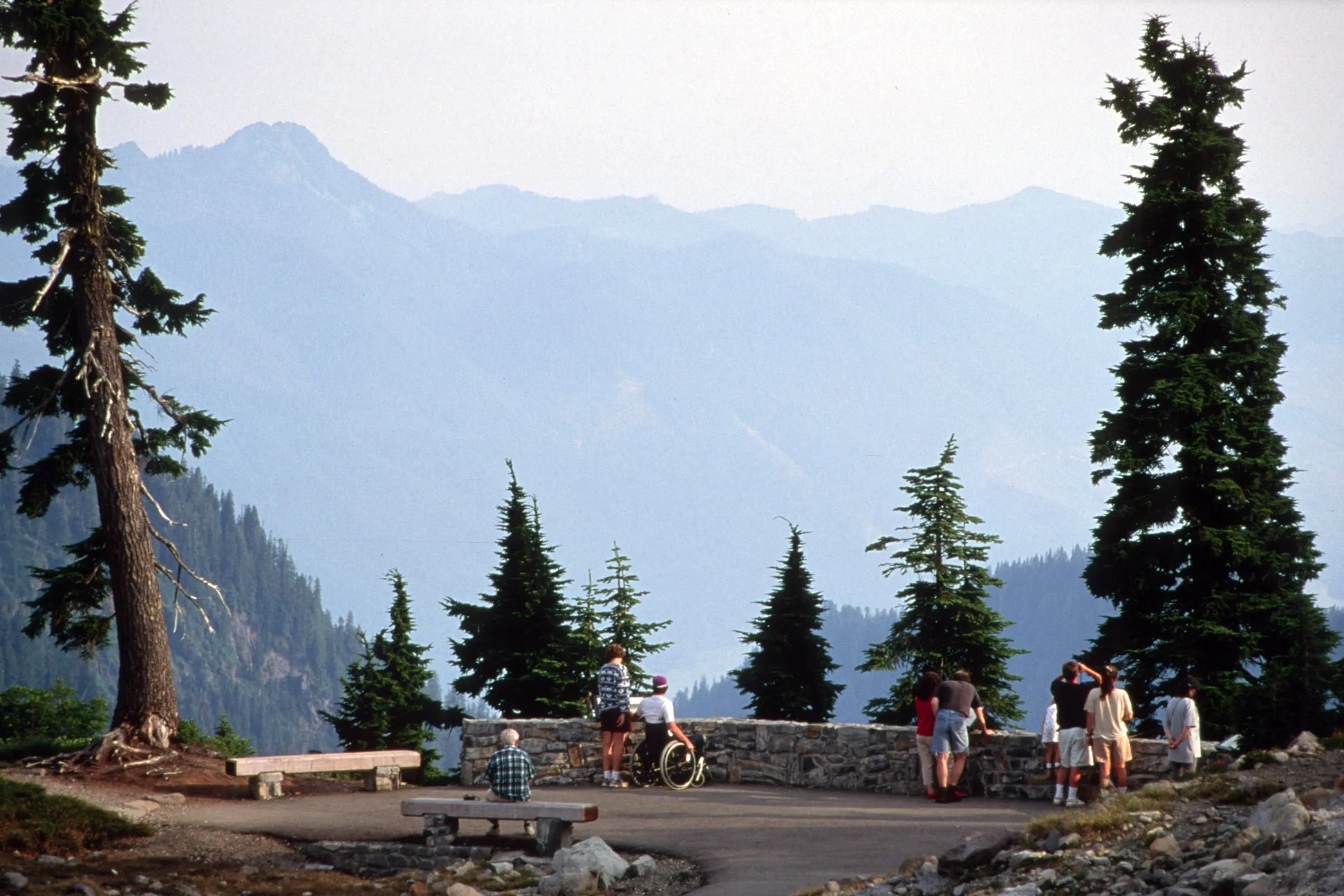 A built Forest Service viewpoint in the Heather Meadows area, photographed in 1994 — the scale of public building up here after the lodge. Photo: Tom Iraci, U.S. Forest Service, Pacific Northwest Region, public domain. Cropped and tonally adjusted.

Can you sleep at the ski area at all?
Only in your own vehicle, only with a reservation, and only in winter. Mt. Baker sells overnight parking at both the Heather Meadows and White Salmon lots from opening day through April 18. Reservations are required. The sites are primitive with no hookups, so a rig has to be self-contained.
The ski area splits it into two products, and the difference matters:
| Overnight parking | What it is | Sleeping in the vehicle |
|---|---|---|
| Occupied | Travel trailer, van, RV, camper truck with people in it | Yes — this is the one you want |
| Unoccupied | A vehicle left while its occupants are in the backcountry | No. “No overnight camping inside vehicle is allowed in these sites” |
Outside the winter season, May through October, overnight parking is a Forest Service matter rather than a ski-area one, handled through the Glacier Public Service Center. And none of this is lodging in any sense a family would recognise. There is no running water, no heat you did not bring, and base-area services vary by day — check the ski area’s operations schedule before you count on anything being open.
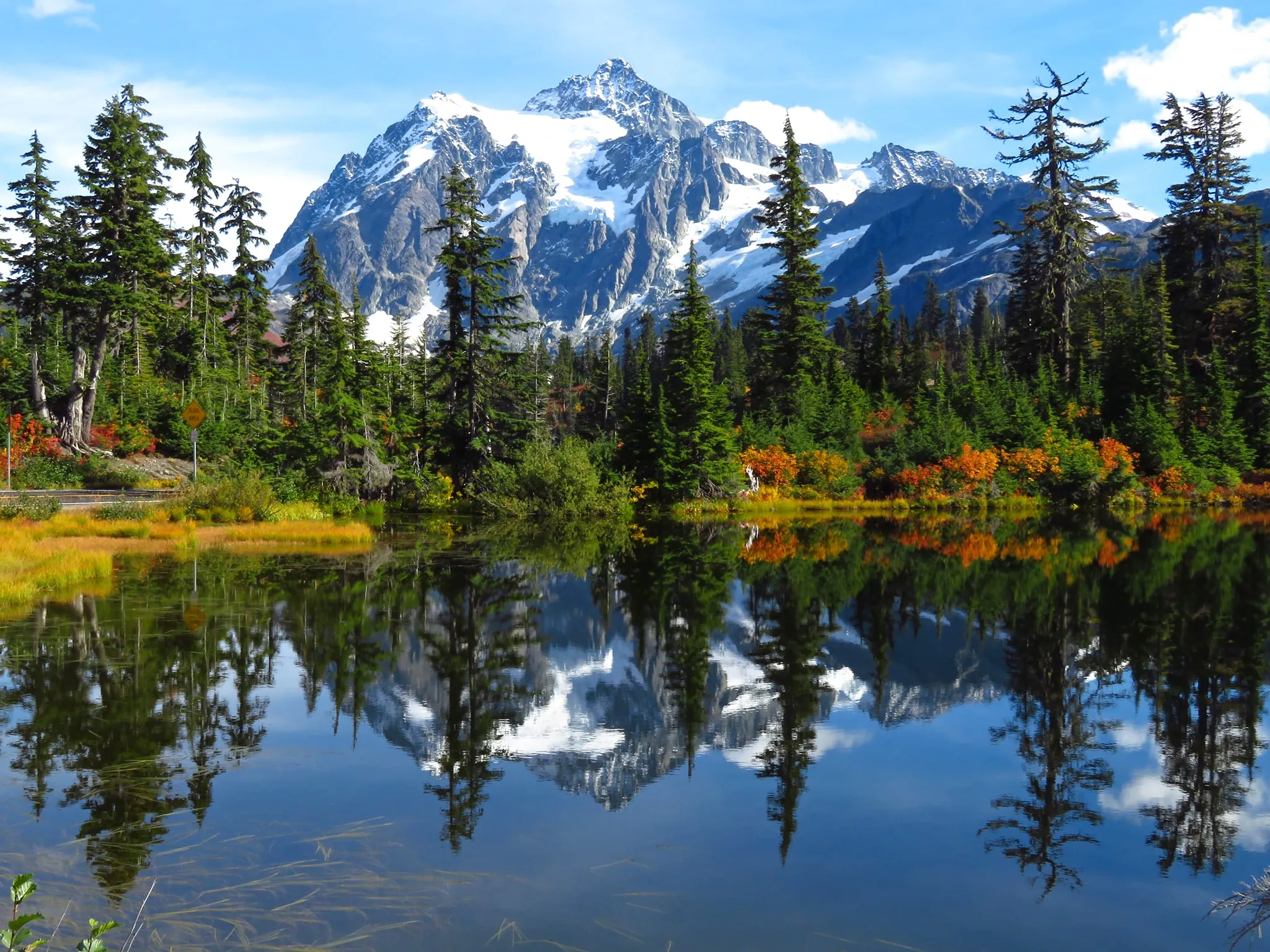 Picture Lake on the Heather Meadows loop, 9 October 2018. Lodge guests had this on their doorstep; today everyone drives up for it. Photo: Jeff Hollett, public domain, via Wikimedia Commons. Edited.

So where do you actually stay for Mt. Baker?
Down the valley, in Glacier or Maple Falls. That has been the answer since 1931 and the drive is the price of it. Glacier is the closest village to the lifts; Maple Falls is fifteen minutes further west and is where the last gas and the last real grocery store are.
| Base | Drive to the lifts | Drive to Heather Meadows in summer |
|---|---|---|
| Glacier, WA | ~30–40 min | ~45 min |
| Maple Falls, WA | ~45 min | ~1 hr |
| Mt. Baker Ski Area | — | — (no lodging) |
The honest tradeoff is that nobody wakes up at the mountain here, so your morning is a drive either way, and what you are choosing between is fifteen minutes of highway and what you get at the other end of the day. We lay the towns out side by side on our where to stay near Mt. Baker page, and the full inventory of who is renting what on the Mt. Baker lodging guide. If you are coming in winter, read the road conditions guide before you book anything — the drive, not the beds, is what usually goes wrong.
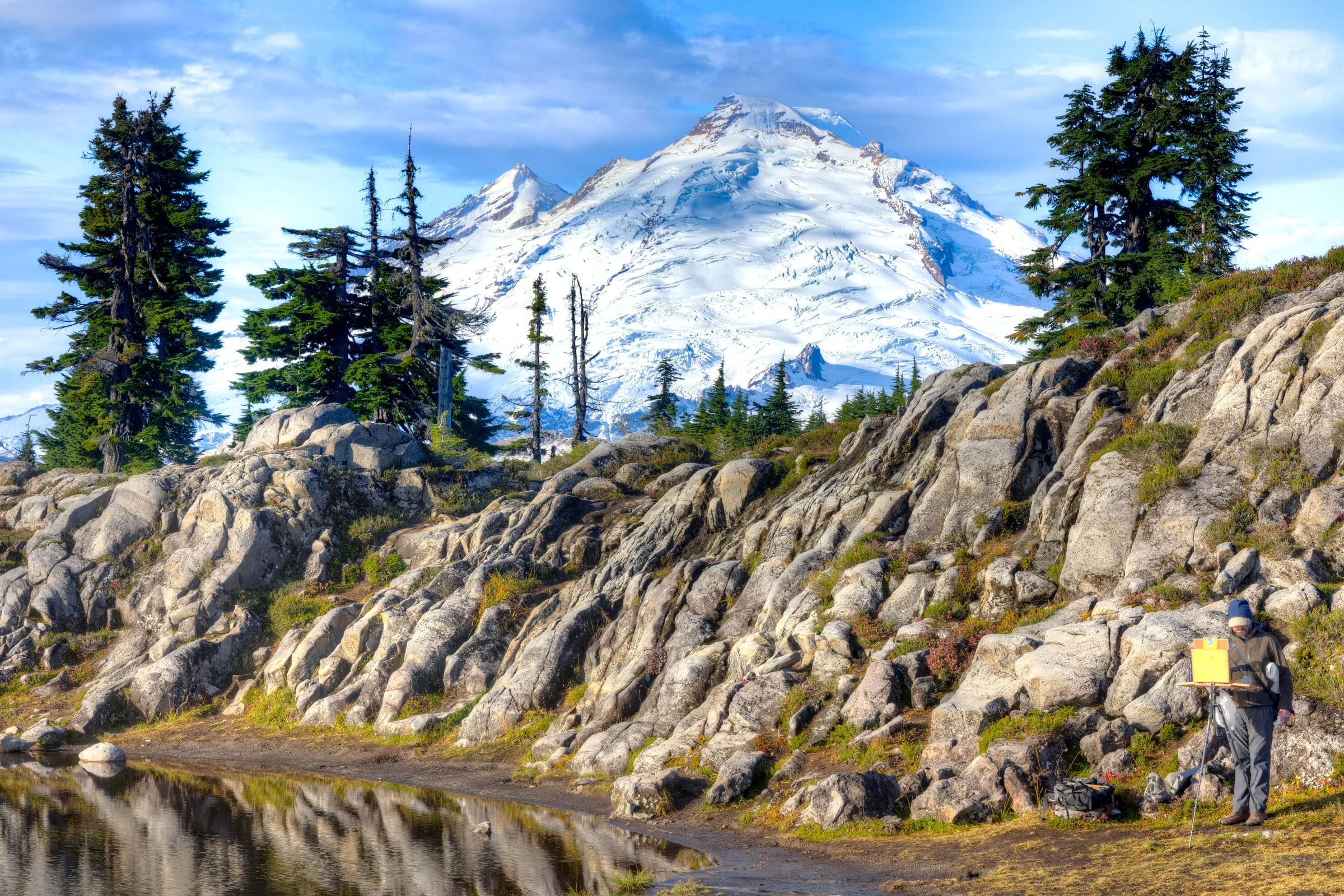 A tarn in the Heather Meadows basin on 6 October 2024, Mount Baker behind — the setting the lodge was built for. Photo: Bob Wick, U.S. Forest Service – Pacific Northwest Region, public domain. Cropped and tonally adjusted.

Where we fit
We host two cabins in the corridor, and neither of them pretends to be a ski-in hotel, because no such thing exists here.
The Black Cedar is the black A-frame near Glacier — three bedrooms, sleeps 6, roughly 40 minutes from the lifts, with a cedar barrel sauna, a hot tub and an espresso bar. It is the shorter drive and the better base for a ski weekend.
The Little Red Cabin in Maple Falls sleeps 4 across two bedrooms, sits about 45 minutes from the ski area and an hour from Heather Meadows in summer, and has a private hot tub, a fire pit and a trail up Red Mountain from the property.
Both are our best rate booked direct from the owners. Both are strict no-pets. Neither is a 100-room hotel with a 130-foot lobby, which is the other thing the corridor lost in 1931 and never got back.
Sources
Everything above was checked against these on October 27, 2026:
- Mt. Baker Ski Area accommodations — “While there are no accommodations located at the ski area”
- Heather Meadows Day Lodge — built in the 1950s, MP 55, 4,300 ft, History Hallway and Taproom
- Mt. Baker Ski Area day lodges and food — White Salmon at MP 52, Raven Hut mid-mountain
- Mt. Baker Ski Area overnight parking — reservations required, occupied vs. unoccupied, opening day to April 18
- The Northern Light, “Mount Baker Lodge stood for 4 years in Heather Meadows” (Ian Haupt, August 10, 2022), drawing on Mike Impero’s The Grand Lady of Mount Baker
- Seattle Times, “Historic images show destiny undone by fire” (Ron Judd, August 24, 2006)
- Pacific Coast Architecture Database: Mount Baker Lodge — architect Earl W. Morrison, constructed 1925–1927, four storeys
- Revisiting Washington: Mount Baker Lodge and Austin Pass Warming Hut — Washington Secretary of State
- Austin Pass Warming Hut, National Register of Historic Places — reference 90001866, listed December 21, 1990
Two things we could not pin down and have left out rather than guessed: the exact footprint of the lodge on the ground, which no source we found maps, and the cause of the fire beyond what newspapers reported at the time. If you have a family photograph of the lodge, we would genuinely like to see it.