Yes, and the part that surprises people is which half works. Both of our cabins run wired Xfinity broadband — 300+ Mbps at the Black Cedar, around 100 Mbps plus an ethernet port at the Little Red Cabin — which is more than any video call asks for. Your phone is the problem. Cell service dies around Kendall, so turn on Wi-Fi Calling before you leave town or you will not get a call, a text or a login code all week.
That gap between “the house has real internet” and “the phone has nothing” is the whole story of working from this valley, and nobody mentions it until you are sitting here at 8 a.m. waiting for a six-digit code that is never going to arrive.
Is the internet at a Mt. Baker cabin fast enough for video calls?
Comfortably. Zoom asks for 3.8 Mbps up and 3.0 Mbps down for 1080p group video, its most demanding meeting mode. Microsoft Teams recommends 2,500 kbps up and 4,000 kbps down for meeting video and says it delivers HD “in under 1.5 Mbps.” Both cabins clear those numbers with room to spare.
Here is what the two platforms actually publish, read from their own documentation today:
| What you are doing | Zoom (up/down) | Microsoft Teams, recommended (up/down) |
|---|---|---|
| Audio-only call | 60–80 kbps | 58 / 58 kbps |
| One-to-one video, 720p | 1.2 / 1.2 Mbps | 1.5 / 1.5 Mbps |
| Group meeting video, 1080p | 3.8 / 3.0 Mbps | 2.5 / 4.0 Mbps |
| Screen share, no webcam | 50–75 kbps | 2.5 / 2.5 Mbps |
| Gallery view, 49 participants | 4.0 Mbps down | — |
Teams’ top “best performance” tier is 4 Mbps in each direction per device. At the Little Red Cabin’s 100 Mbps that is twenty-five simultaneous devices on the download side; at the Black Cedar it is more than seventy. Microsoft also notes that when bandwidth does run short, Teams “prioritizes audio quality over video quality” — so the failure mode is a frozen picture, not a dropped meeting.
One honest caveat. Those are download figures, which is what we measure and publish; cable upload is always a fraction of cable download, and we do not publish a measured upload number for either cabin. For calls, screen sharing and ordinary work it has never been the limiting factor. If your week involves pushing large video files or multi-gigabyte builds upstream on a deadline, message us before you book and we will go and test it rather than let you find out on a Tuesday.
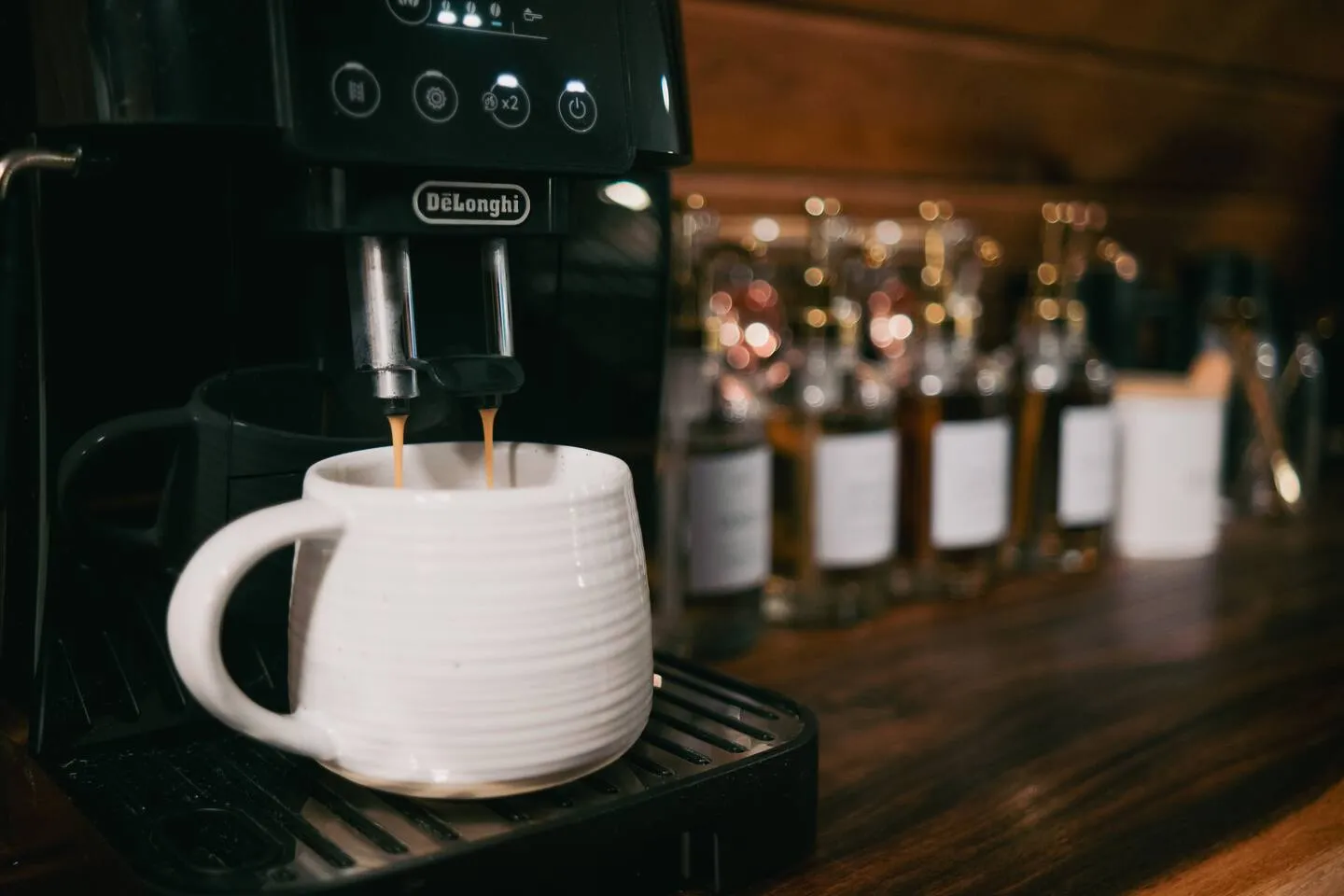 The espresso bar at the Black Cedar is free and fully stocked, which removes the single most common reason to leave the cabin on a workday. Our photo.
Why does the wifi work when your phone does not?
Because they are completely different networks. The cable that reaches houses along the Mt. Baker Highway has nothing to do with the cell towers that are not there. Signal thins out from Kendall eastward with pockets at best in Glacier, so people describe the corridor as having “no internet” when what they mean is no bars.
We wrote the full version of this in is there cell service at Mt. Baker — where the signal ends, which phones reach a satellite, how to text 911. For a work week the practical consequences are narrower and sharper:
- No hotspot fallback. If the cabin’s internet drops, your phone cannot rescue you, because your phone is already relying on the cabin’s internet.
- SMS two-factor codes do not arrive unless your texts are travelling over wifi. This is the one that ruins mornings.
- Nobody can reach you on your mobile by default, including whoever is covering for you at home.
- Navigation, Slack huddles and calendar alerts all stop the moment you pull out of the driveway.
 The window seat at the Black Cedar. The view is the point; the bars on that phone are not. Our photo.
How do you get calls and texts with no signal?
Wi-Fi Calling, set up before you drive. Every major US carrier supports it, it is built into the phone’s normal dialler and messages app, and it routes calls and texts over the cabin’s broadband instead of a tower. Apple’s own guidance is to use it “in an area with little or no cellular coverage.” Verizon says you “may be able to make and receive calls and texts over a Wi-Fi network.”
Three things make this fail, and all three are easier to fix in Bellingham than in Glacier:
- It has to be switched on while you still have a signal. On an iPhone it lives in Settings → Cellular → Wi-Fi Calling. Verizon notes that an iPhone has to connect to its network in the US before the feature will enable.
- You have to confirm an emergency address. Both Apple and Verizon require a registered address for 911, because a Wi-Fi call carries no tower location. Verizon is explicit that if you are not at the registered address, a 911 call “may not reach the closest emergency provider” — so update it to the cabin’s address if you are here for a week.
- Your two-factor method needs checking. Once Wi-Fi Calling is on, SMS codes arrive normally. If it is off, they do not arrive at all. An authenticator app sidesteps the problem entirely and is worth setting up before a week in a dead zone.
Apple also notes that when cellular is unavailable, emergency calls themselves may go over Wi-Fi Calling. That is worth knowing in a valley where a landline is not a given.
What actually ruins a work week up here?
Power. Not snow, not the drive, not bandwidth. Whatcom County is in Puget Sound Energy’s electric territory — one of the eight counties it serves with electricity — and winter storms in the foothills take lines down. When the power goes, the broadband goes, and because there is no cell service there is no second route to the internet at all.
What we tell guests who are working: say up front that you are somewhere with one path to the internet, keep documents available offline the way you would download everything before driving up, bookmark PSE’s outage map rather than relying on a search you will not be able to run, and finish a hard midweek deadline early. Most weeks nothing happens. The point is that when something does, it takes the phone and the internet together, which is a different kind of outage from the one you get at home.
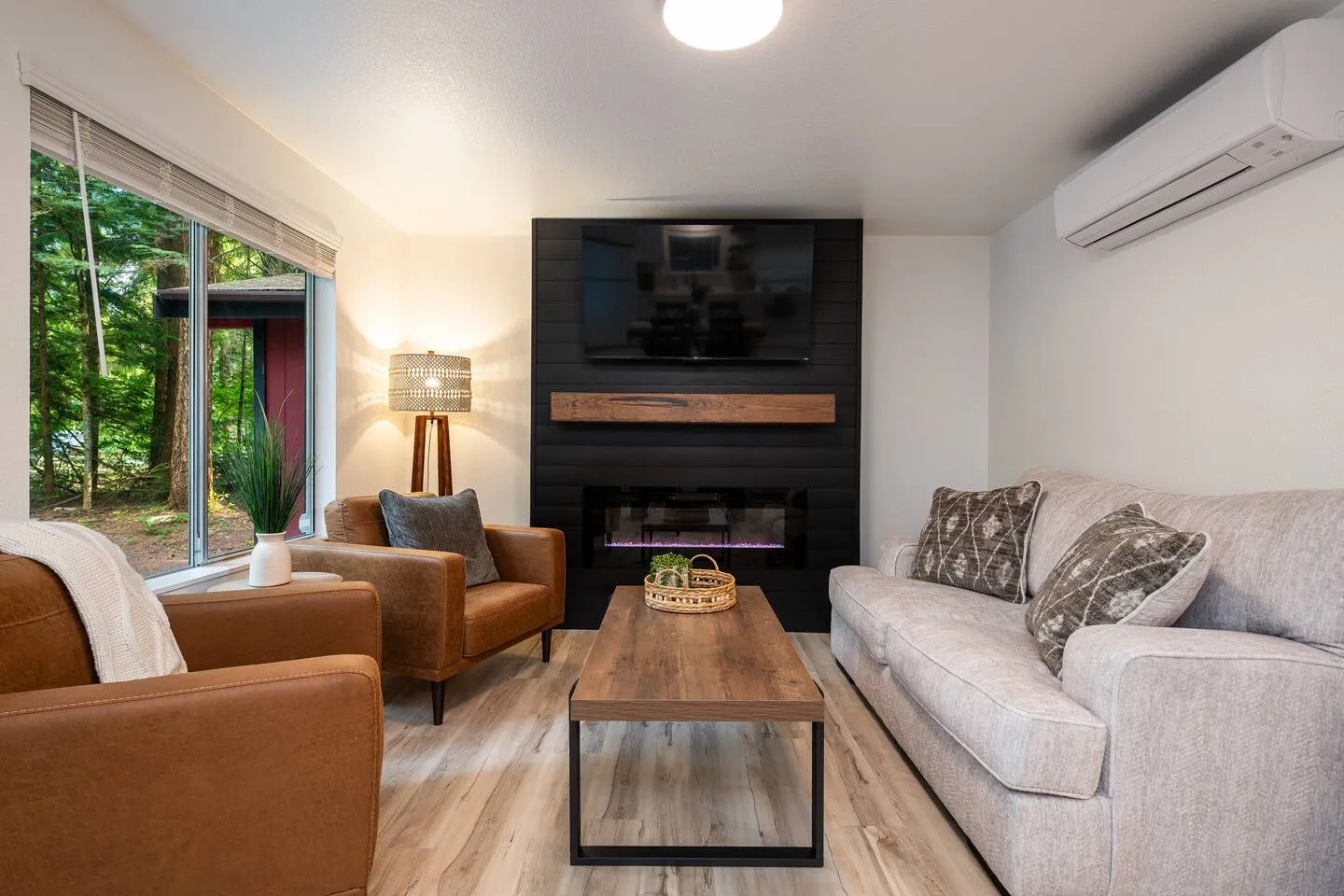 The Little Red Cabin’s living room, mini-split on the wall. The ethernet port is the reason people take the calls that matter from this cabin. Our photo.
Where do you actually sit and work in each cabin?
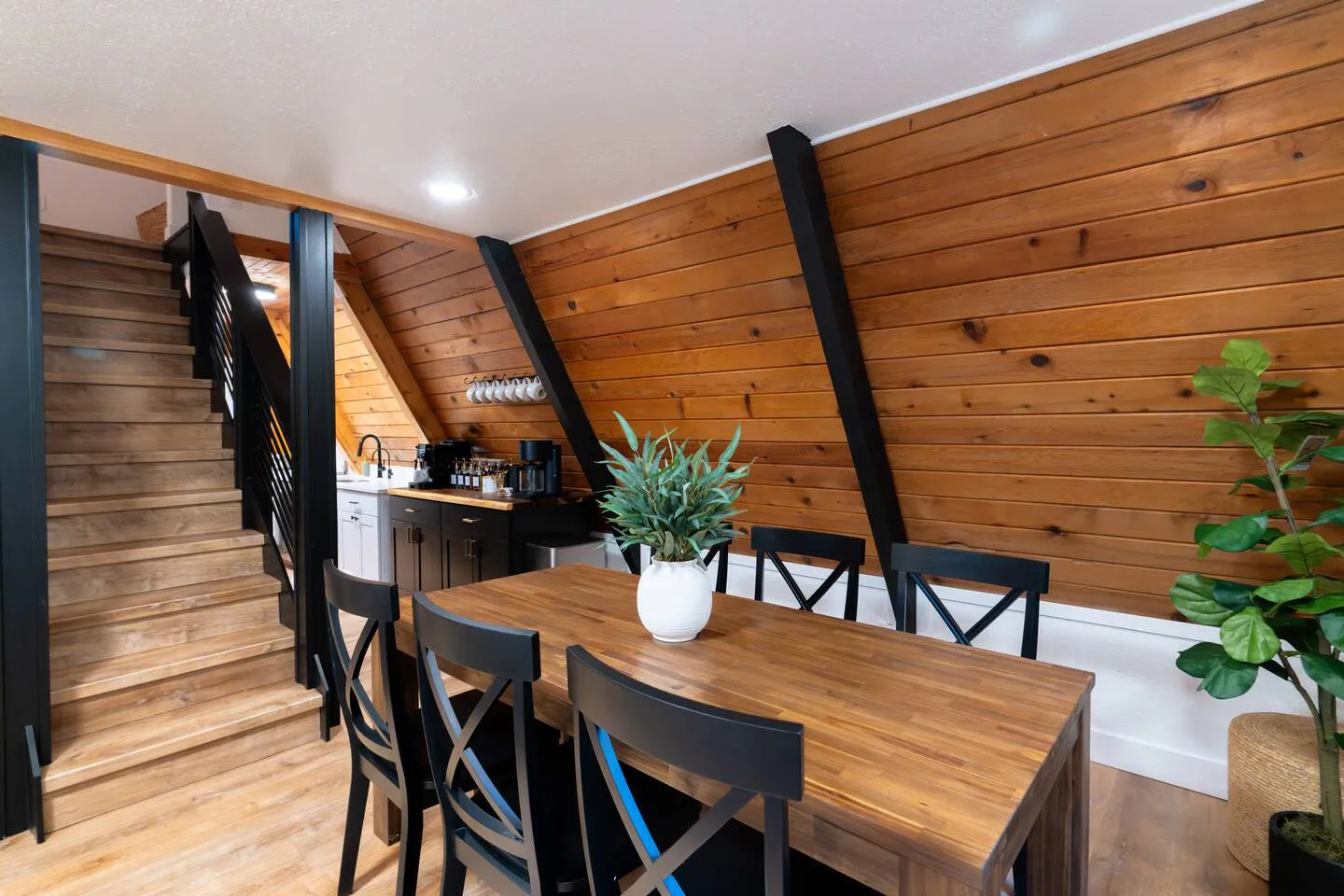
At a table, in both cases, because neither cabin is an office and we are not going to pretend otherwise. The Black Cedar has a dedicated workspace plus a long dining table under the A-frame slope. The Little Red Cabin has a large dining table in front of the window wall, and the only ethernet port of the two.
The A-frame’s table is the one in the photo at the top of this page: it seats a group, it sits directly under the espresso bar, and the stairs behind it mean someone else can be upstairs and out of your frame. The Little Red Cabin is a single-level layout, so a call in the main room is a call the whole cabin hears — fine for two people, harder for four.
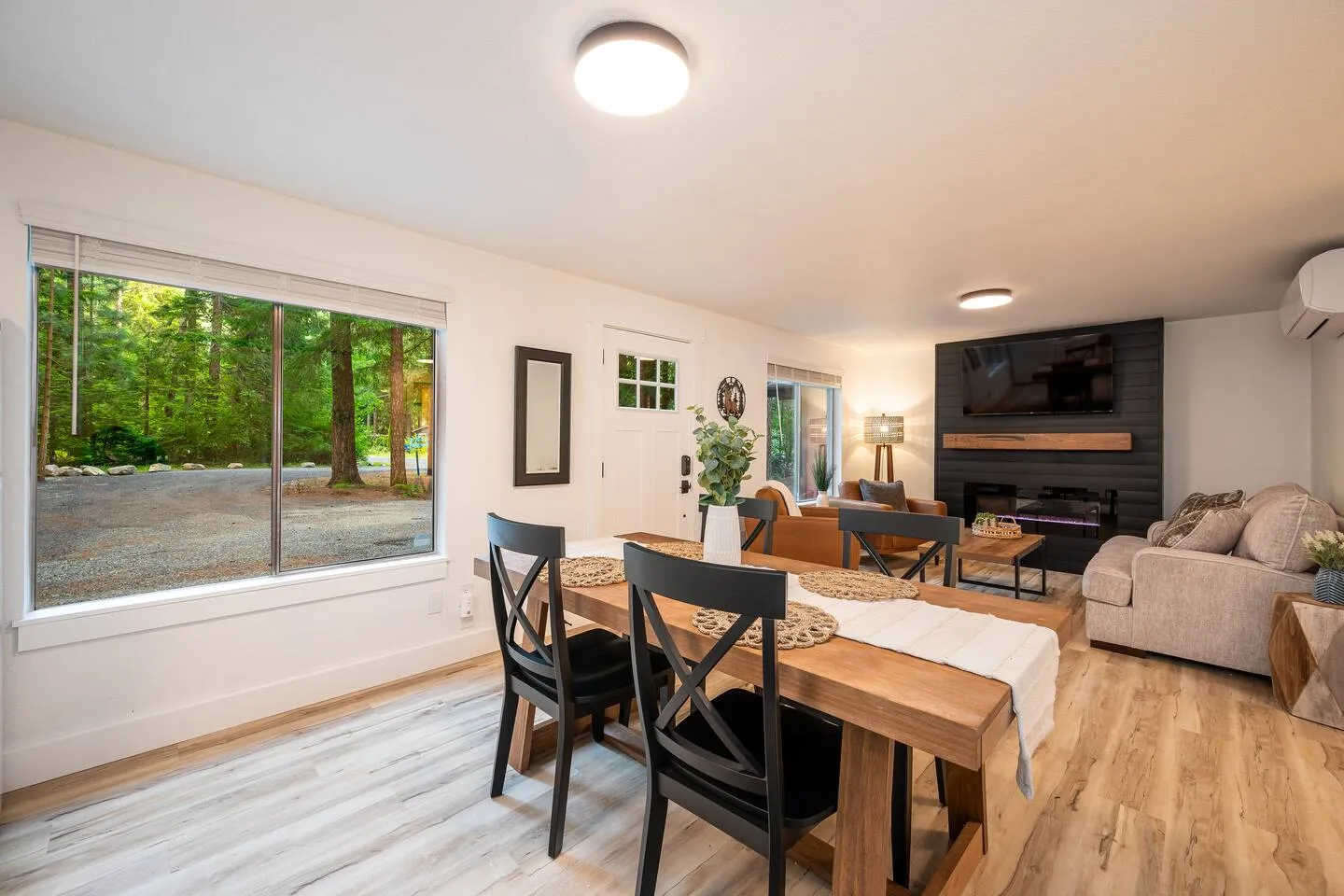 The Little Red Cabin’s table faces the window and the driveway, which is the best light in the house between about 10 a.m. and 2 p.m. Our photo.
Both cabins have a full-size washer and dryer, which matters more on a seven-day stay than on a weekend, and both allow long-term stays. Pack for four days, not seven.
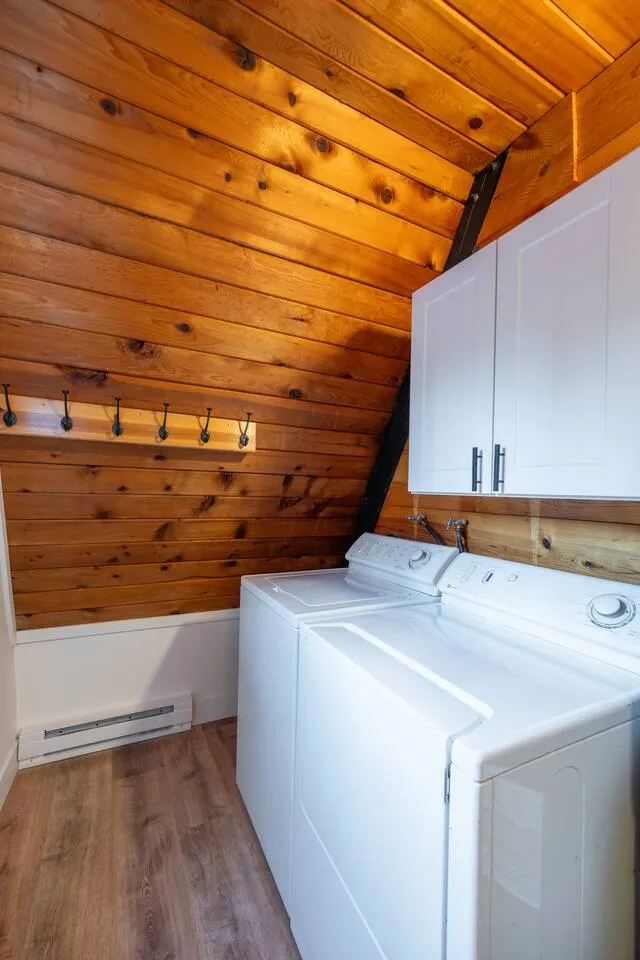 Full-size washer and dryer at the Black Cedar. The reason a week’s luggage looks like a weekend’s. Our photo.
Is there anywhere to work outside the cabin?
One reliable public option: the North Fork Library in Maple Falls, at 7506 Kendall Road, open Tuesday and Thursday 10 a.m.–8 p.m., Wednesday and Friday 10 a.m.–6 p.m., and Saturday 10 a.m.–5 p.m. It is closed Sunday and Monday. That is the full list of dependable indoor public workspace in the upper valley, and it is a small branch, not a coworking space.
A 2020 Whatcom County Library System notice lists free outdoor wifi at its branches including North Fork, available around the clock. We could not confirm on a current page that the outdoor network is still running, so call the branch at (360) 599-2020 before you count on it rather than driving fifteen minutes on our say-so.
Beyond that, the corridor’s cafés and pubs are small, seasonal and busy on weekends, and their posted hours move — Glacier and Maple Falls each have a town guide with what is actually there. There is no all-day coworking café up the valley, and we would rather say so plainly than send you fifteen minutes up the road to a table that may not be open.
What does a working day here look like in winter?
Short, and the time zone you work in decides everything. Glacier sits at about 48.9°N, so the sun sets at 4:13 p.m. around the solstice. A 9-to-5 Pacific day ends in the dark every day from early November into late January. A 9-to-5 Eastern day ends at 2 p.m. Pacific, with the afternoon still ahead of you.
These are computed for the cabins’ latitude from the US Naval Observatory’s rise-and-set data, across the 2026-27 season:
| Date | Sunrise | Sunset | Daylight left after a 2 p.m. Pacific finish |
|---|---|---|---|
| Oct 23 | 7:41 a.m. | 6:03 p.m. | 4 h 3 m |
| Nov 17 | 7:21 a.m. | 4:25 p.m. | 2 h 25 m |
| Dec 21 | 7:59 a.m. | 4:13 p.m. | 2 h 13 m |
| Jan 20 | 7:52 a.m. | 4:46 p.m. | 2 h 46 m |
| Feb 17 | 7:13 a.m. | 5:32 p.m. | 3 h 32 m |
| Mar 17 | 7:17 a.m. | 7:16 p.m. | 5 h 16 m |
If your team is on Eastern time, this is the best argument for the trip. You finish at 2, and in February you still have three and a half hours of light. If your team is on Pacific time, be realistic: your outdoor time is the weekend and the lunch hour.
Can you ski after work at Mt. Baker?
Not really, and the mountain’s own numbers are why. Mt. Baker Ski Area runs 9:00 a.m. to 3:30 p.m. and answers a flat “No” to night skiing. Nothing spins after the working day ends on Pacific time.
The afternoon ticket is the only version of “after work” the mountain sells, and it starts at 12:00 p.m. For 2026-27 that is $99.72 adult peak and $84.95 off-peak, before 8.3% Washington sales tax. Compare it with the all-day adult rate of $115.42 peak and $98.80 off-peak and the discount is about 14% for half a day, which is poor value if you only turn up at 2 p.m. with ninety minutes of lift time left.
The honest version: a ski week here means taking a half day, not squeezing laps into the margins. Off-peak lift tickets run Monday to Thursday on non-holidays, tickets are sold day-of at the ski area only — no pre-purchase, no digital, no multi-day — and midweek at Mt. Baker covers what else changes when you are here on a Tuesday. What the afternoons are genuinely good for is a walk, a soak and an early dinner.
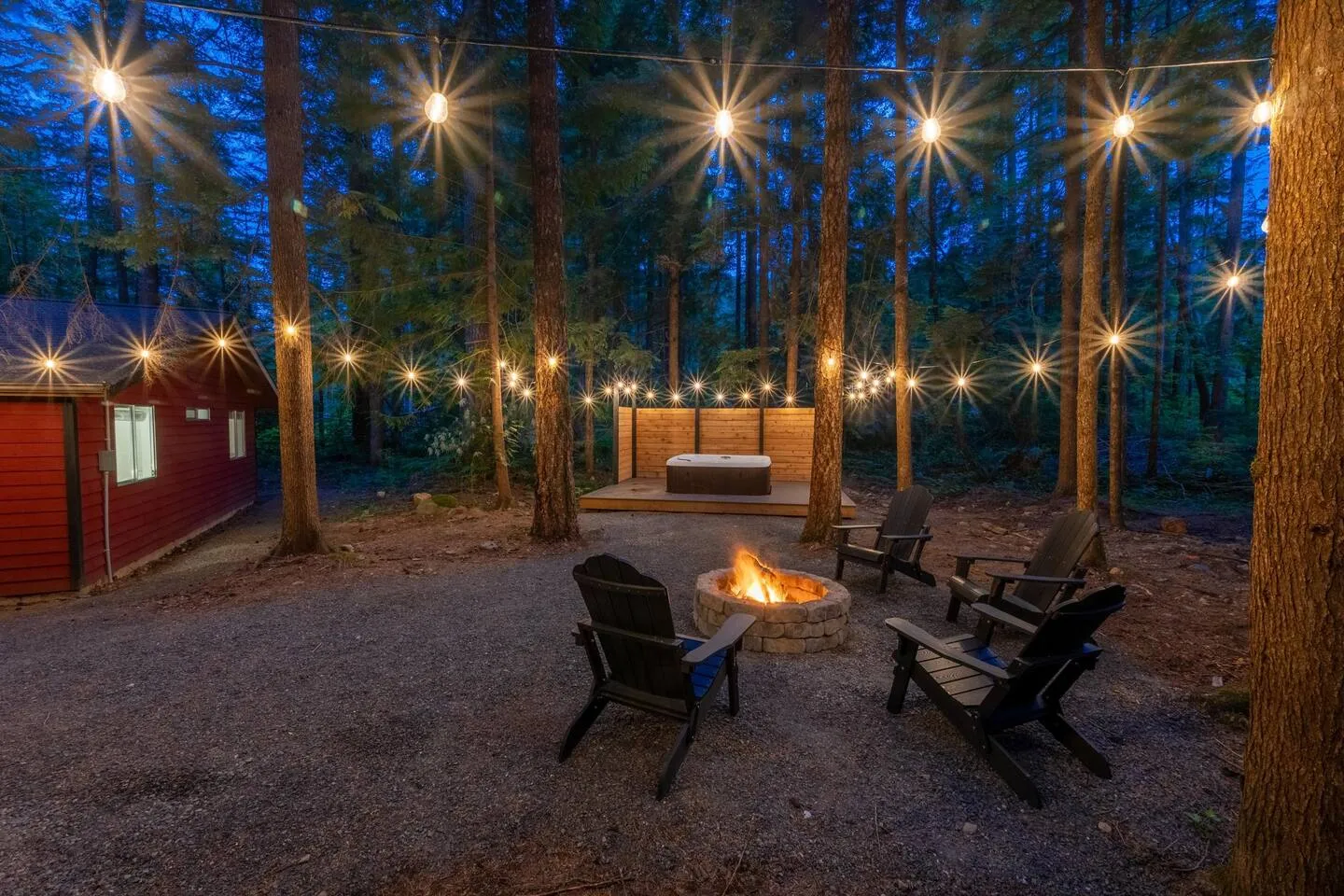 The fire pit and string lights at the Little Red Cabin. From November into January the light is gone by about 4:30 p.m., so this is the end of the working day for most of the winter. Our photo.
What do you need to bring for a week?
Groceries for most of it, chains in winter, and anything you cannot buy in a town of a few hundred people. Maple Falls holds the last grocery store and the last gas on the highway; Glacier has food and coffee but no fuel. Shop in Bellingham on the way up and you will not lose an afternoon to it.
| Item | Where it comes from | Why it matters on a week stay |
|---|---|---|
| Groceries | Bellingham on the drive up; Maple Falls for top-ups | The last grocery is in Maple Falls, not Glacier |
| Fuel | Maple Falls | There is no gas in Glacier |
| Tire chains | Bring them, Nov–Apr | Required equipment in posted zones on SR 542 |
| Offline copies of work files | Before you leave Bellingham | One internet path, no cell backup |
| An authenticator app | Set up at home | SMS codes need Wi-Fi Calling switched on |
Check road conditions before any drive up or down the valley, and remember that a storm closing SR 542 is a storm that keeps you here — which is fine if your week is already indoors and inconvenient if you have a flight.
Which cabin is better for a work week?
Depends on bandwidth versus errands. The Black Cedar has three times the download speed, a dedicated workspace, the free espresso bar and the sauna. The Little Red Cabin has the ethernet port, a single-level layout and sits right where the gas, the grocery store and the library are.
| The Black Cedar | The Little Red Cabin | |
|---|---|---|
| Town | Glacier, WA | Maple Falls, WA |
| Wifi | 300+ Mbps Xfinity | ~100 Mbps Xfinity + ethernet |
| Workspace | Dedicated workspace and a long dining table | Large dining table at the window wall |
| Sleeps | 6, in 3 bedrooms | 4, in 2 bedrooms |
| To the ski area | ~40 min | 45 min |
| To the last gas and grocery | 15 min (Maple Falls) | In town |
| To Bellingham | 30 min | 35 min |
| Also has | Cedar barrel sauna, hot tub, outdoor shower, free espresso bar, A/C | Private hot tub, fire pit, mini-split A/C and heat, trail up Red Mountain |
Two or three people with a hard call schedule and an Eastern-time job: the Black Cedar, for the bandwidth and because three bedrooms give you somewhere else to take a call from. A couple who wants the shortest trip to the store and a wired connection for the calls that cannot drop: the Little Red Cabin.
Both check in at 4 p.m. and out at 10 a.m., both are strictly no-pets, and both show live availability on their own pages, which is where to look rather than asking us for dates. If you are still weighing the two towns, where to stay for Mt. Baker lays out the tradeoff and Mt. Baker lodging covers what exists in the corridor as a whole. Midweek is when a work week is cheapest and quietest, and how far ahead to book has the pattern behind that.
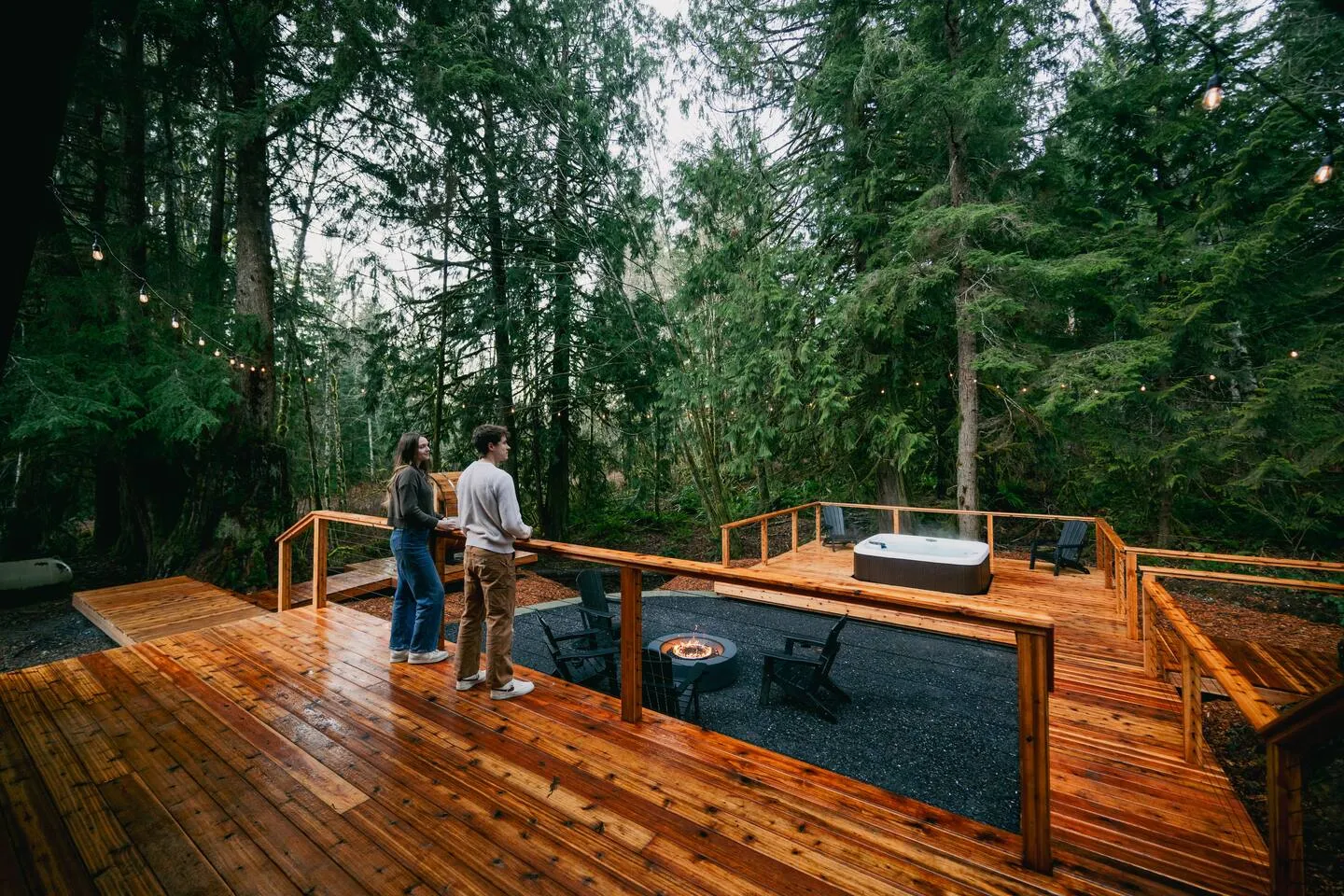 The deck at the Black Cedar, hot tub and fire pit beyond. Our photo.
Sources, all read October 23, 2026: Zoom’s system requirements and bandwidth table; Microsoft’s Prepare your organization’s network for Teams bandwidth table; Apple’s Wi-Fi Calling support page; Verizon’s Wi-Fi Calling FAQs; Puget Sound Energy’s service-area page; the Whatcom County Library System locations page for North Fork Library’s address, phone and hours; Mt. Baker Ski Area’s mountain FAQ, daily lift ticket pricing and afternoon ticket pricing; and sunrise and sunset times computed for 48.92°N, 122.00°W from the US Naval Observatory rise-set service. Cabin speeds, amenities and drive times are our own.
Cut for lack of a source: a measured upload figure for either cabin, and Xfinity’s published upload speeds, because Xfinity’s own plan page would not load and the third-party numbers disagreed with each other. Also cut: the Maple Falls post office hours, because the USPS location tool kept resolving to a post office in another state; and the FCC’s 100/20 Mbps broadband benchmark, which is widely reported but which we could not read on fcc.gov today.
Last verified: 2026-10-23. Lift prices, library hours and carrier settings all change. Check the ski area, the library and your own carrier before you rely on any of them.