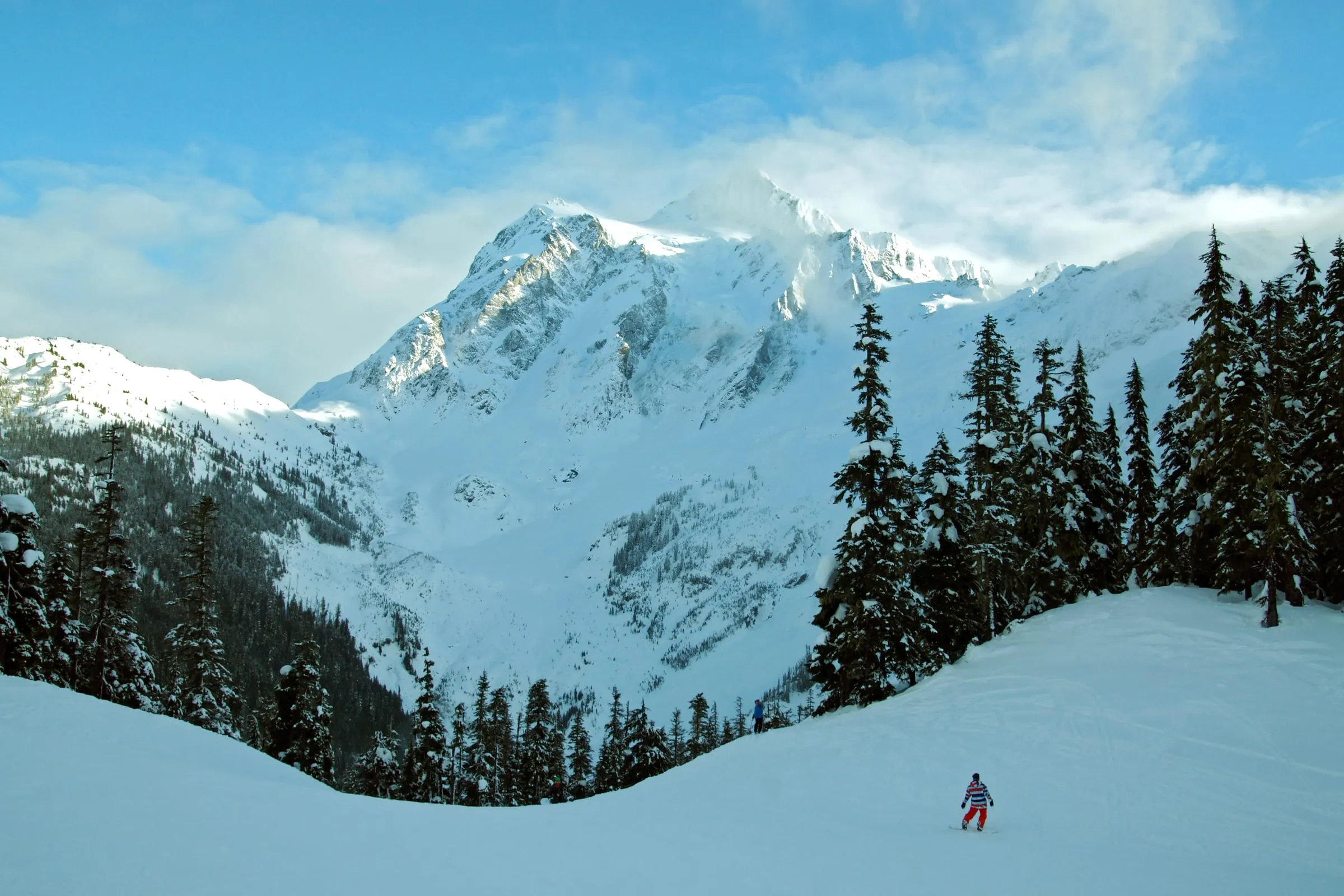
Yes, and more than most mountains. Mt. Baker allowed snowboards when most ski areas still banned them, hosted the first banked slalom in February 1985, and prints a run called Natural Halfpipe on its own trail map. The terrain rewards riders who like natural features and long fall-line pitches. The thing it asks in return is tolerance for cat tracks and traverses, which is the honest catch.
That is the short version. Here is the longer one, checked today against Mt. Baker’s own pages and its 2026–27 trail map.
Why is Mt. Baker famous for snowboarding?
Because it said yes first. In the early 1980s most North American ski areas banned snowboards outright. Mt. Baker’s general manager, Duncan Howat, saw no reason to, and a group of riders from Mount Vernon — Craig Kelly, Gillian Kelly, Jeff Fulton and Dan Donnelly, who became the Mount Baker Hard Core — made the mountain their home hill. That decision is why the sport’s defining race happens here and not somewhere else.
In 1984 Fulton’s group, Bob Barci and Tom Sims of Sims Snowboards approached Howat with an idea: a race down a gully on the White Salmon run that forms a natural halfpipe. The first one ran in February 1985 under the name Sims Open. Sims won it. Terry Kidwell was second, Ken Achenbach third, and a young Craig Kelly fourth. Mount Baker Experience tells that origin story in full.
Forty-plus years later the Legendary Banked Slalom is still the biggest weekend of this valley’s year, and the winner still gets a duct-tape trophy. The 37th LBS runs February 19–21, 2027, per the event’s own site — we cover the dates, spectating and lodging in our Legendary Banked Slalom 2027 guide.
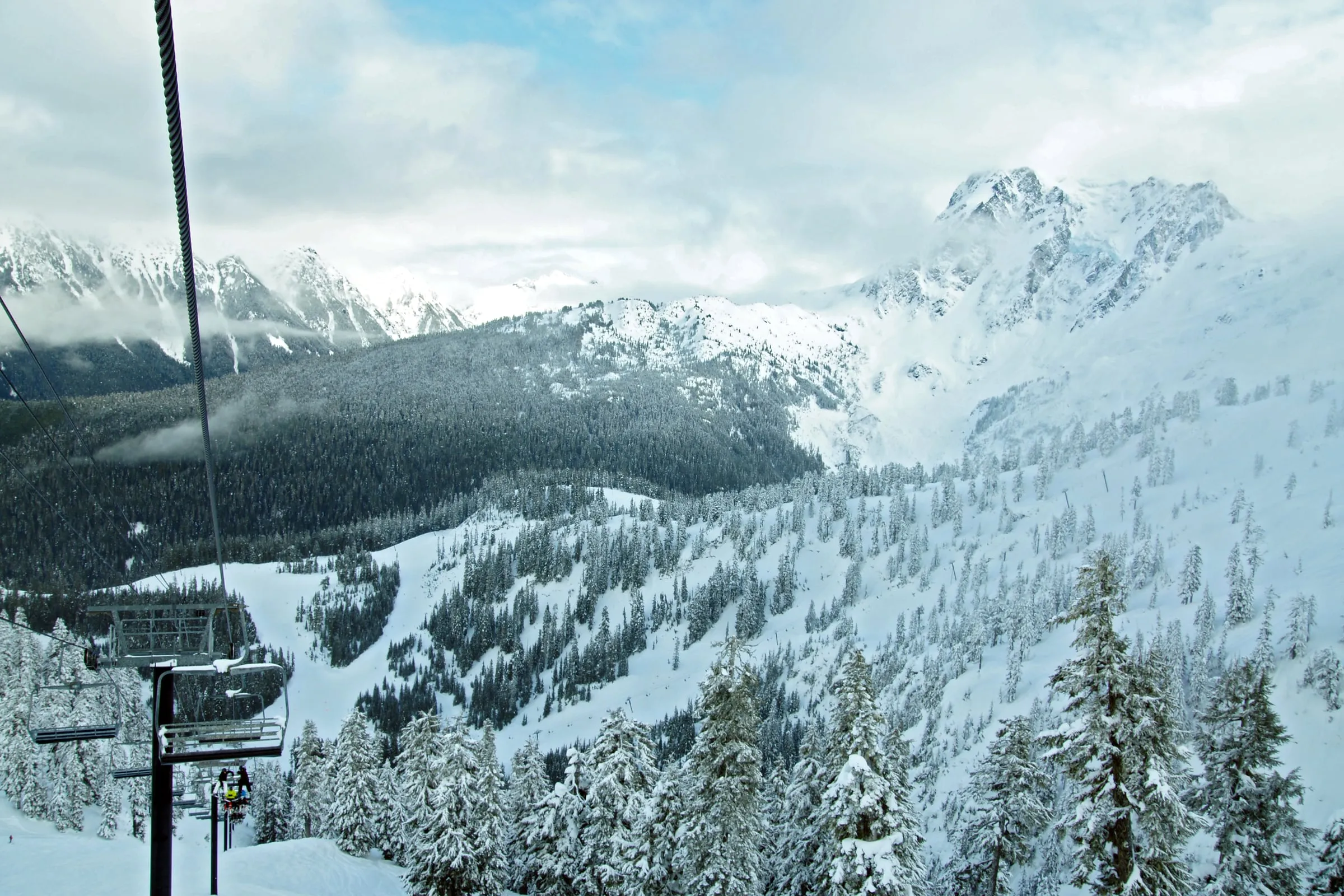 Fixed-grip chairs, no high-speed anything, and Mount Shuksan in the background of most of the mountain. Photo: kallerna, CC BY-SA 3.0, via Wikimedia Commons. Edited.

Where is the Natural Halfpipe, and can you ride it on a normal day?
It is a marked run on the Shuksan Side, printed as Natural Halfpipe on the 2026–27 trail map between Diehl’s and Gabl’s, and it snakes away from the top of Chair 5. On a normal operating day it is simply open terrain. It is only closed and fenced in the run-up to the Banked Slalom, when the course is set inside it.
Gwyn Howat, the ski area’s CEO, has set that course for 34 years and calls it “the only perfect natural halfpipe in the world,” citing its width, length and pitch — Cascadia Daily News, February 4, 2025. The same piece describes how it gets built: a trail broken down the closed run through hip-deep powder, snowboarders sent down to firm the surface, a snowcat shaping two rollers and a hard turn at the finish. Howat’s line on the division of labor is worth keeping: “it takes skiers to set the course because of the maneuvering,” but “it takes snowboarders to carve the course because of the way they hit turns.”
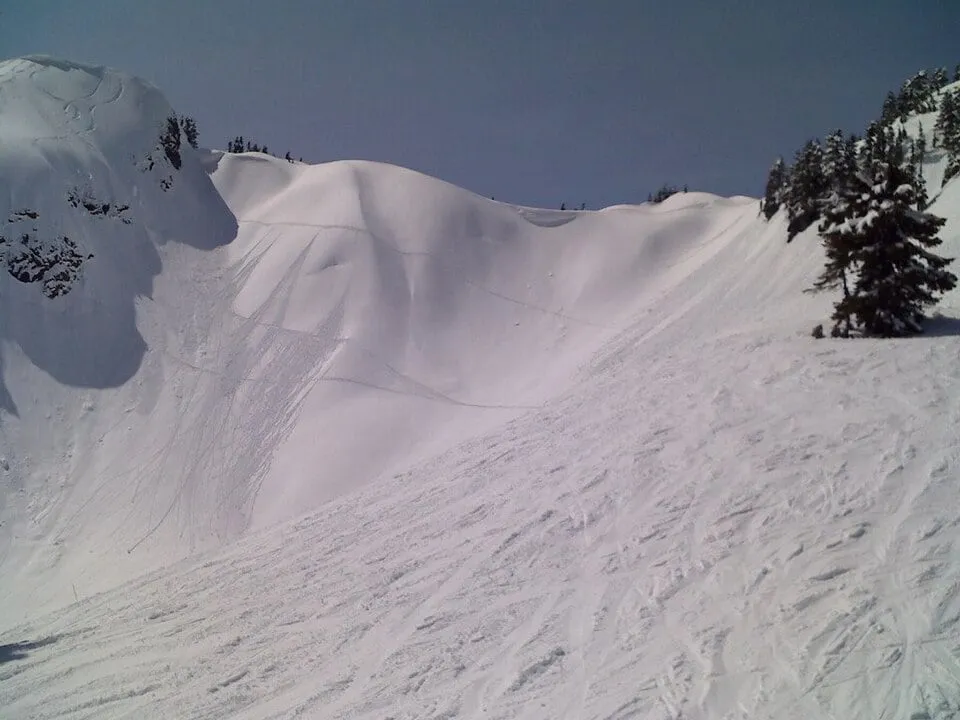
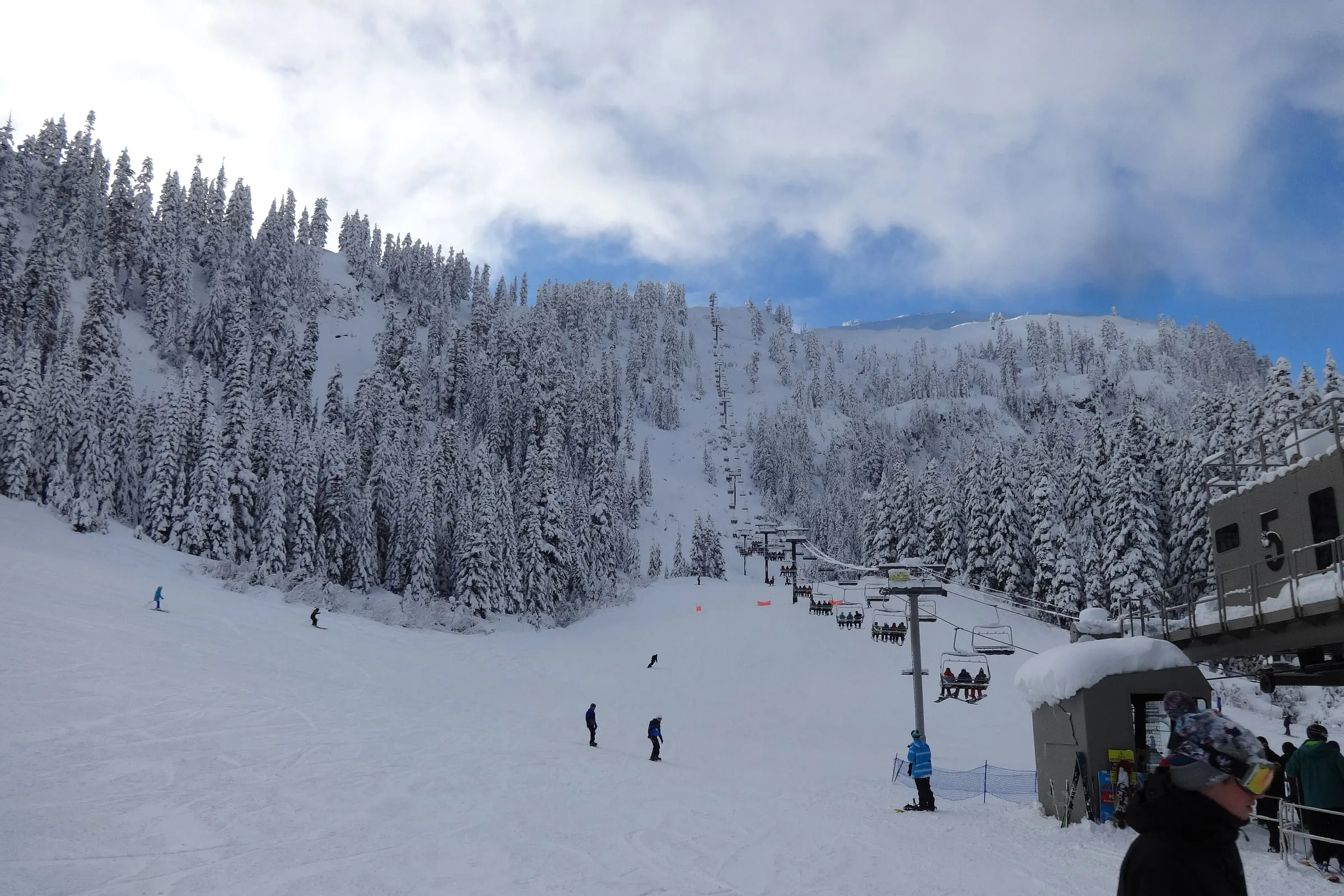 Chair 5 over Gabl’s. The Natural Halfpipe is the next feature across, and the race course is set inside it. Photo: SherpardH1239a, CC0, via Wikimedia Commons.

What is the terrain actually like to ride?
Compact, steep for its size, and almost entirely natural. Mt. Baker publishes 1,000 skiable acres and 1,500 feet of vertical, served by eight quad chairs and two handle tows, across two base areas — White Salmon at the bottom and Heather Meadows above it. There are no high-speed lifts and no snowmaking anywhere on the hill.
The trail map’s own difficulty legend tells you something about the place. Most mountains label the blue square “intermediate.” Baker labels it Difficult, the black diamond More Difficult, and the double black Experts Only. Chair 1 is printed as an experts-only lift with no unload at the midstation. We dug into whether that wording is real or marketing in are Mt. Baker’s blue runs really blue?.
| What Mt. Baker publishes | Figure |
|---|---|
| Skiable acres | 1,000 |
| Vertical rise | 1,500 ft |
| Lifts | 8 quad chairs, 2 handle tows |
| White Salmon base | 3,600 ft (trail map) |
| Heather Meadows base | 4,210 ft (trail map) |
| Shuksan Side, top of Chair 8 | 5,089 ft |
| Panorama Dome | 5,011 ft |
| Operating hours | 9:00 AM – 3:30 PM |
| Snowmaking | None |
One caution on those numbers: the ski area’s mountain stats page prints base elevations of 3,500 and 4,300 ft, its FAQ repeats them, the trail map prints 3,600 and 4,210, and today’s snow report gives 3,630 and 4,210. We use the figures above from the current map and say where each one came from rather than pretending the mountain agrees with itself.
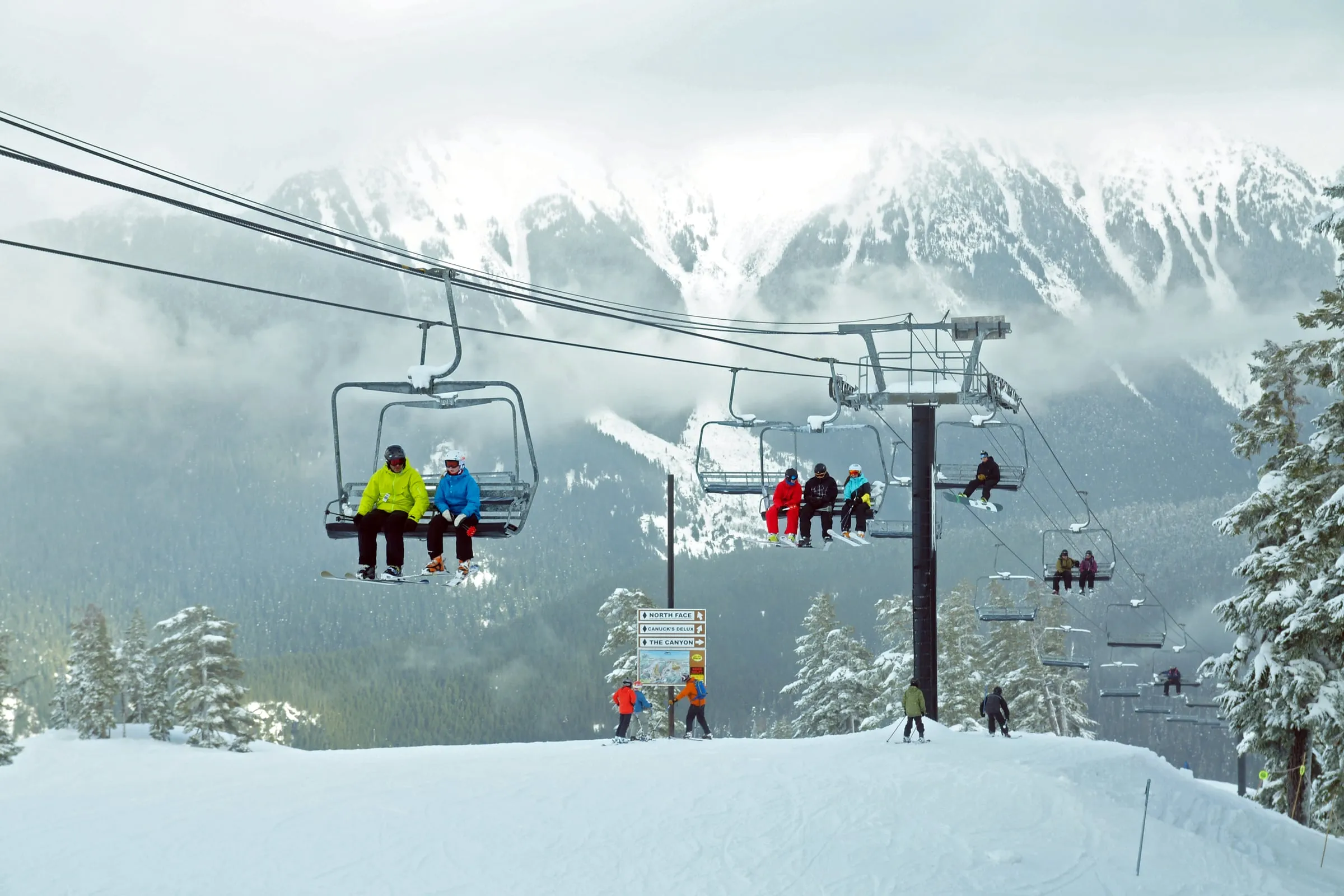 North Face, Canuck’s Delight, The Canyon. The run names at Baker are not decorative. Photo: kallerna, CC BY-SA 3.0, via Wikimedia Commons. Edited.

Which traverses and cat tracks catch snowboarders out?
The two named ones, Honkers Cat Track and Blueberry Cat Track, plus the linking runs between the base areas. Baker is two base areas stitched together by flat-ish connectors, and on a snowboard a flat connector is work. The trail map prints a whole panel of lodge-to-lodge routes because people get stranded on the wrong side.
| Direction | Route the map prints |
|---|---|
| Heather Meadows → White Salmon | Chair 2 Access → Chair 3 → Big Creek → Honkers Cat Track → Raven Hut → Chair 5 → White Salmon |
| Heather Meadows → White Salmon (alt) | Expresso → White Salmon |
| White Salmon → Heather Meadows | White Salmon → Chair 7 → Bobcat → Expresso → Lower White Salmon → Raven Hut |
| White Salmon → Heather Meadows (cont.) | Chair 4 → Mitzi’s → Chair 2 → Home Run / 7 Hills → Heather Meadows |
Two practical notes that follow from this. First, carry speed onto a cat track, because there is no lift to bail you out of a flat section and no road shuttle between the bases — the Summer Road that links them sits inside the ski area and needs a valid lift product. Second, if your group is split across both bases, agree which lodge you are eating in before you load, not after. Our chair-by-chair guide for first-timers maps the sequence properly.
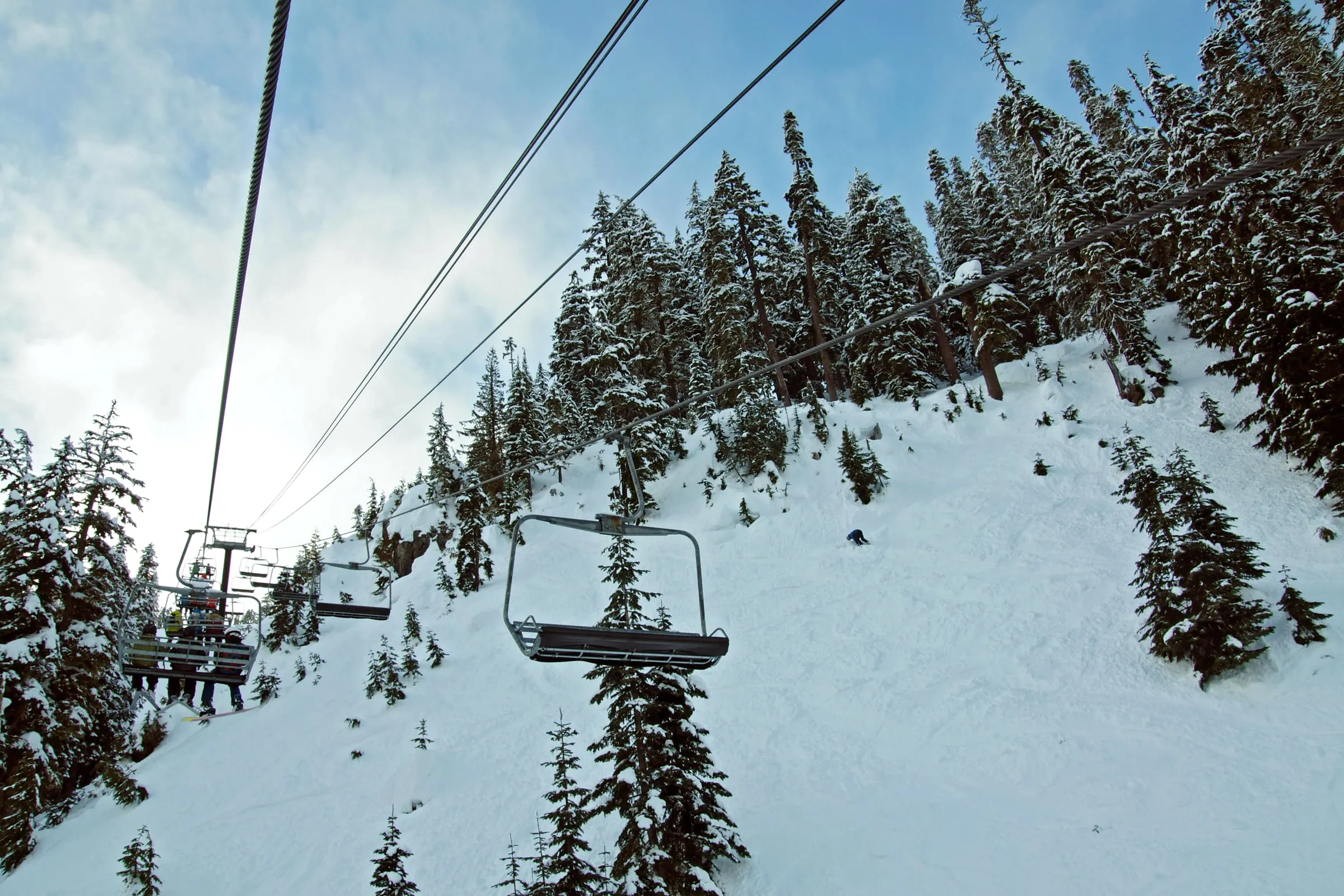 Midweek at Baker. The lifts are slow, the lines are short, and the trees are the point — which is also why tree wells and deep snow are the hazard to understand here. Photo: kallerna, CC BY-SA 3.0, via Wikimedia Commons. Edited.

Does Mt. Baker have a terrain park?
It has a Freestyle Feature Zone called The Sticks, not a jump park. The ski area places it “near the top of Chair ¾ in between Big Creek (beginner) and Sneaky Pete (intermediate) runs” — Chair 7 then Chair 4 from White Salmon, or Chair 3 directly from Heather Meadows. Individual features and lines open and close through the day.
The framing on the ski area’s own page is about balance and edge control rather than booters, and it runs Freestyle Clinics for people brand new to features, plus the Last Stand Rail Jam and the Branch Out Session. If you are arriving expecting a built park with a sequenced jump line, read our full write-up of The Sticks first so the day is not a disappointment.
Can a first-time snowboarder learn here?
Yes, but the day you come decides where you learn. Lessons at the White Salmon lodge are midweek, non-holidays only; weekend and holiday instruction happens at Heather Meadows. Rentals split the same way at White Salmon: premium rentals daily, basic rentals midweek.
Check the snow report for the day’s actual operations before you drive up, because those schedules move. Prices for lessons, rentals and tickets are in our what a Mt. Baker ski day costs and ski and snowboard rentals guides. One thing you cannot do is pre-buy: Mt. Baker’s FAQ states that daily lift tickets are “available for purchase day-of at the ski area only,” with no digital or multi-day tickets.
 The top of Chair 8 late in a season. Everything you see fell out of the sky; Baker makes no snow at all. Photo: Wavepacket, CC BY 3.0, via Wikimedia Commons. Edited.

What about riding past the rope?
Treat it as a different sport. The trail map marks the ski area boundary in red with the words “no return to ski area” on the Shuksan Side and above Panorama Dome, and the ski area’s standing advisory says that outside the boundary you are in “UNCONTROLLED, UNPATROLLED NATIONAL FOREST,” that the terrain is not controlled for avalanches, that no ski patrol services are available, and that a 911 or search-and-rescue response “is typically a minimum of hours away at best.”
The Shuksan Arm — Chair 5’s original name — is the famous one, and it is also where people get hurt. Read the NWAC forecast for the day and our guide to the Mt. Baker avalanche forecast, which covers the four items the ski area requires before you leave the boundary and what a rescue actually costs here.
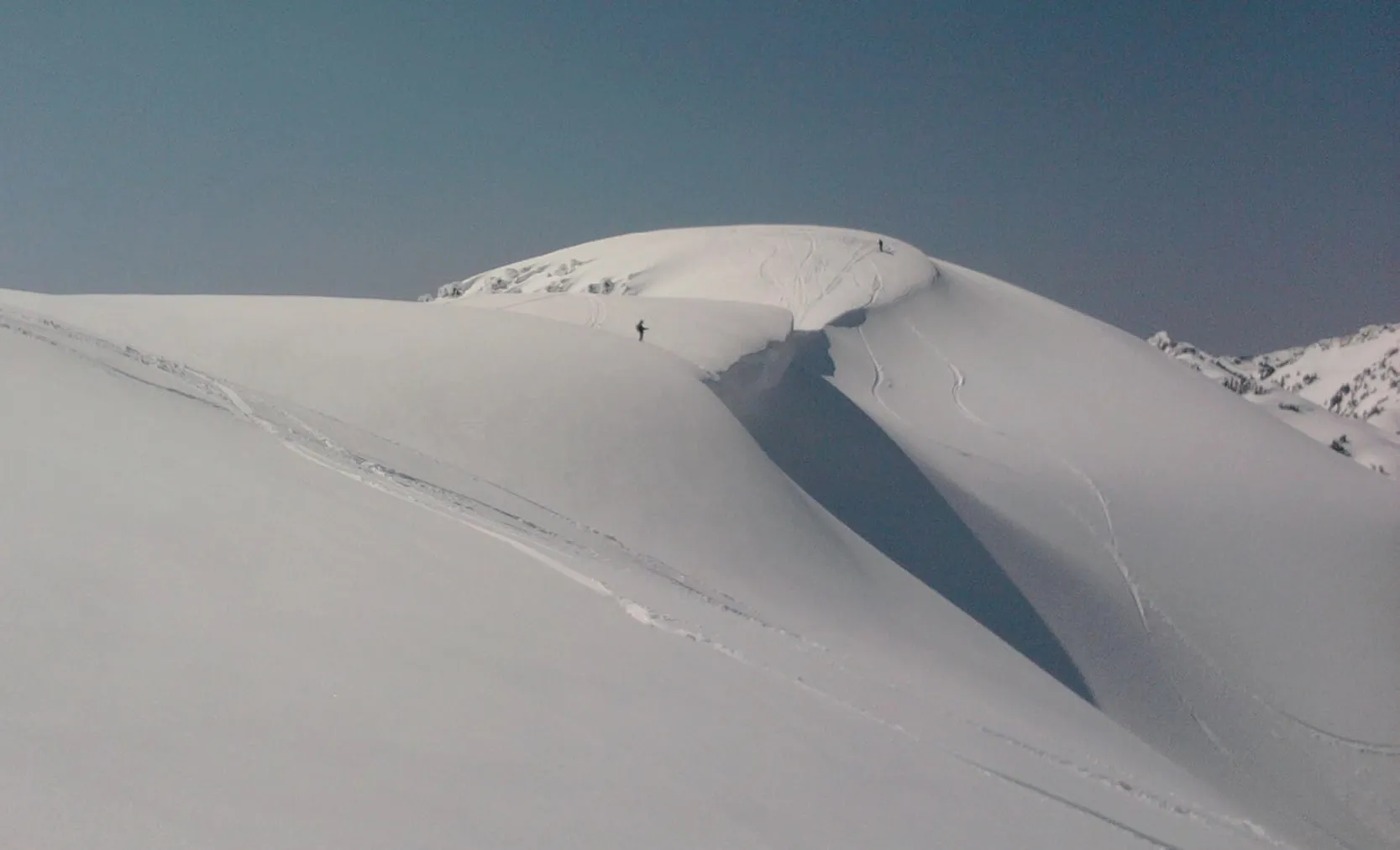 The Shuksan Arm cornice, with tracks on the loaded slope beneath it. This is outside the boundary. Photo: OrionGeo310, CC0, via Wikimedia Commons.

How much snow does it get, and when can you ride this season?
A lot, and nobody knows yet. Mt. Baker’s published snowfall table averages 663 inches over the fifteen complete seasons from 2010–11 through 2024–25, which matches the figure its FAQ gives; its mountain stats page says 688, so take any single number loosely. The record is the one that is not in dispute: 1,140 inches in 1998–99, verified by NOAA as a world record for a single season, which we tell properly in the world snowfall record.
As of today the mountain is closed and has no opening date. The most recent snow report, dated November 5, 2026, records a 3-inch base at Heather Meadows after about 36 inches fell in late October and partly melted off, and states the opening rule plainly: Baker relies “100% on natural snowfall,” needs somewhere between 20 and 40 inches of base depending on density, and needs a forecast that will not wash it away. Staff training was set for the following weekend, after which the crew will “push the start button” when snowfall and forecast align.
| Season | Published total (inches) |
|---|---|
| 2025–26 | 502 |
| 2024–25 | 585 |
| 2023–24 | 508 |
| 2022–23 | 617 |
| 2021–22 | 648 |
| 2020–21 | 704 |
| 1998–99 (record) | 1,140 |
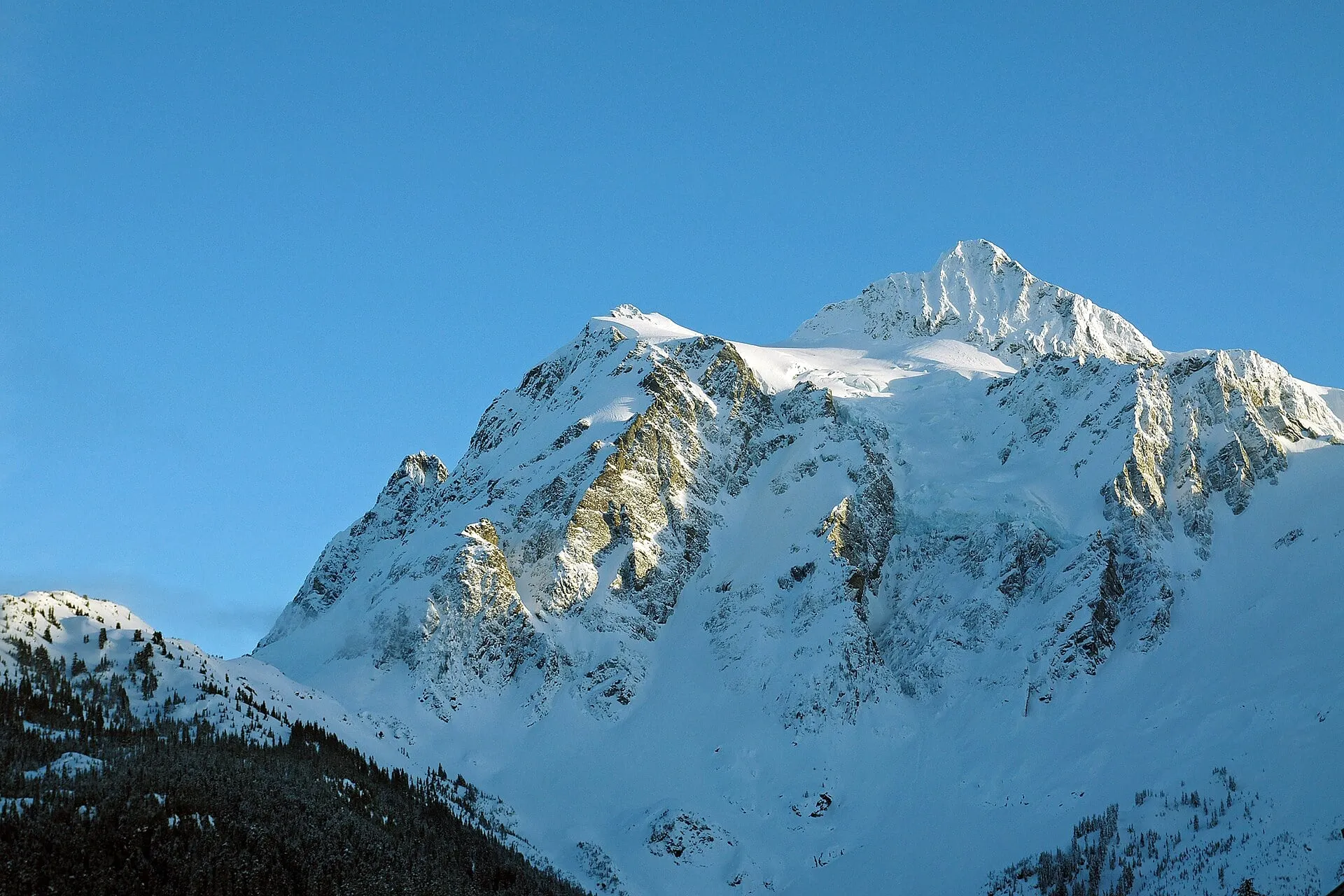 Shuksan carrying a midwinter load, seen from inside the ski area. None of it was made by a machine. Photo: kallerna, CC BY-SA 3.0, via Wikimedia Commons. Edited.

We track the announcement as it happens in when does Mt. Baker open?, and the drive itself — chains, closures, which webcam lies — in our road conditions guide.
Where we’d put you for a Baker snowboard trip
Close enough to make first chair, far enough that you can actually sleep. There is no lodging at the ski area at all, so every rider on the hill drove up that morning from somewhere down-valley.
The Black Cedar in Glacier is the one we send riders to. It is a black A-frame sleeping 6 across three bedrooms, about 40 minutes from the lifts, with a cedar barrel sauna in the woods, a hot tub and a free espresso bar for the 7 a.m. start. After a day of Baker’s cat tracks, the sauna earns its keep.
The Little Red Cabin in Maple Falls sleeps 4 in two bedrooms, 45 minutes out, with a private hot tub and a fire pit. It is the cheaper base for a pair or a small crew, and 15 minutes further down means the last gas and the only real grocery are on your doorstep rather than behind you.
Either way, book before the opening date is announced rather than after — the whole valley fills within hours of that post. Our Mt. Baker lodging guide lays out what else exists in the corridor and why so little of it is left.
Last verified: 2026-11-13. Sources: Mt. Baker Ski Area mountain stats, mountain info FAQ, The Sticks, White Salmon Day Lodge, snowfall statistics and snow report pages, plus the 2026–27 trail map; Legendary Banked Slalom; Mount Baker Experience; Cascadia Daily News.